
The Ultimate Central Coast Wedding Guest Experience Guide
Planning a Central Coast Destination Wedding in Carmel, Monterey, Big Sur, Santa Cruz & Ben Lomond
By Justin Warwick — DJ Warwick, DJ Enterprises Mobile Disc Jockey
There’s a special kind of excitement that comes with planning a destination wedding on California’s Central Coast. Few places offer such a remarkable combination of natural beauty, charming coastal communities, historic properties, world-class resorts, scenic vineyards, and majestic redwood forests. Whether you envision an elegant celebration overlooking the Pacific Ocean, a romantic ceremony beneath centuries-old oak trees, or an intimate gathering surrounded by towering redwoods, this region offers an extraordinary variety of wedding experiences.
For couples planning their wedding in Carmel-by-the-Sea, Monterey, Pebble Beach, Carmel Valley, Big Sur, Santa Cruz, or the mountain communities surrounding Ben Lomond, the possibilities are almost endless. Yet while choosing the perfect location is certainly important, there’s another aspect of destination wedding planning that deserves just as much attention: the experience you’re creating for the people who will be celebrating with you.
Your wedding guests may be traveling hundreds or even thousands of miles to share this occasion. They’ll be arranging transportation, booking accommodations, requesting time away from work, and navigating a destination that may be completely unfamiliar to them. Some will turn the trip into a vacation, while others may have only enough time to attend the wedding itself. Older family members may have accessibility concerns, parents may be traveling with young children, and guests unfamiliar with the Central Coast may underestimate the distances between its most popular communities.
As a professional wedding DJ and Master of Ceremonies with more than 35 years of experience, I’ve participated in nearly 3,000 weddings and special events throughout California. I’ve worked at everything from luxurious coastal resorts and historic hotels to private estates, ranches, wineries, country clubs, and secluded properties in the Santa Cruz Mountains.
Over the years, I’ve learned that a wedding’s success involves much more than a beautiful ceremony, exceptional food, or an energetic dance floor. The way guests experience the entire celebration, from the moment they begin making travel arrangements until they return home, can have a tremendous influence on how they remember your wedding.
A thoughtfully planned destination wedding doesn’t require an extravagant budget or an elaborate weekend itinerary. It requires understanding what your guests need, communicating important information clearly, and making decisions that allow everyone to relax and enjoy the occasion.
This guide explores how to create that experience while navigating the distinctive geography, accommodations, transportation considerations, and wedding venues found throughout the Monterey Bay and Santa Cruz regions. Along the way, we’ll take a closer look at 15 exceptional Central Coast wedding properties and the practical considerations that make each one different.
1. Begin With Your Guests, Not Just Your Wedding Venue
When couples begin searching for wedding venues, they’re naturally drawn to photographs of spectacular ceremony backdrops, beautifully decorated reception spaces, and breathtaking coastal scenery. It’s easy to imagine exchanging vows on a bluff overlooking the ocean or celebrating beneath the redwoods at a secluded mountain retreat.
However, a location that looks extraordinary in photographs may present challenges that aren’t immediately apparent during a venue tour.
Before committing to a property, consider how your guests will reach it, where they’ll stay, and what their experience will be like once they arrive.
A resort in downtown Monterey may offer convenient access to hotels, restaurants, parking, and nearby attractions. A private estate in Carmel Valley might provide a wonderfully secluded atmosphere but require guests to drive considerable distances from their accommodations. A wedding venue in the Santa Cruz Mountains could offer an unforgettable natural setting while presenting challenges involving narrow roads, limited cellular reception, or transportation after dark.
None of these considerations should automatically discourage you from choosing a particular location. They simply deserve attention before you sign a contract.
Consider the People on Your Guest List
Every wedding guest list is different. Some couples are inviting primarily local friends and family, while others are bringing together people from several states or countries.
Think about the age range of your guests, whether anyone has mobility limitations, and how many families will be traveling with children.
Will most guests rent cars, or will they depend on transportation arranged by the couple? Are your closest family members comfortable navigating winding mountain roads? Will elderly relatives be able to move easily between the ceremony and reception locations?
A venue with extensive lawns, gravel pathways, or multiple event areas may require additional accommodations for guests who have difficulty walking long distances.
The objective isn’t to eliminate every possible inconvenience. That’s rarely realistic. Instead, identify potential difficulties early enough to provide thoughtful solutions.
One lesson I’ve learned from years of working at weddings is that guest comfort often influences the atmosphere of the entire celebration. When people arrive relaxed, understand where they’re supposed to be, and feel that their needs have been considered, they’re much more likely to enjoy themselves.
Think Beyond the Wedding Day
Destination weddings offer an opportunity to spend more time with friends and family than a traditional local celebration might allow.
Some guests will arrive a day or two early, while others may extend their visit to explore the Central Coast. This creates opportunities for welcome gatherings, rehearsal dinners, informal family activities, and farewell brunches.
However, these experiences should complement the wedding rather than create unnecessary obligations.
Guests may appreciate a few recommendations and opportunities to gather, but they should also feel free to enjoy the destination independently.
The best approach is to create a welcoming environment while allowing everyone enough flexibility to enjoy the experience in their own way.
2. Understanding the Different Wedding Destinations of the Central Coast

One of the greatest advantages of planning a wedding in this region is the variety of settings available within a relatively compact geographic area. However, visitors sometimes assume that neighboring communities are practically interchangeable.
They’re not.
Each destination has its own personality, accommodations, transportation considerations, and practical advantages.
The following locations and wedding venues illustrate how dramatically the guest experience can vary throughout the Central Coast.
Carmel-by-the-Sea: Romance, Walkability, and Coastal Charm
Carmel-by-the-Sea is internationally recognized for its picturesque streets, distinctive architecture, art galleries, restaurants, and beautiful coastline. It’s an appealing destination for couples who want their guests to enjoy a romantic coastal getaway as part of the wedding celebration.
For visitors staying within the village, many shops, restaurants, and attractions are accessible on foot. This can make the experience particularly enjoyable for guests who prefer not to drive every time they leave their hotel.
However, Carmel’s charming village layout also comes with practical considerations.
Parking can be limited in busy areas, hotel accommodations vary considerably in size and amenities, and some properties have stairs or layouts that may not be suitable for every guest. Street addresses can also be less intuitive than visitors expect, so providing clear directions is especially helpful.
Couples should remember that a wedding described as being “in Carmel” might actually take place in Carmel Valley, Pebble Beach, or another nearby community. Those locations can require additional travel, even when guests have booked accommodations in Carmel-by-the-Sea.
Mission Ranch: A Classic Carmel Wedding Experience
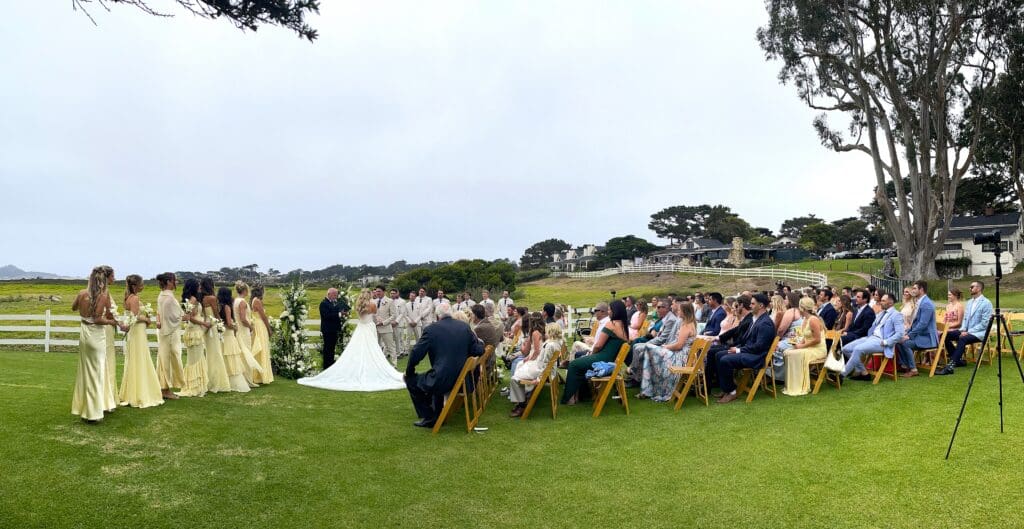
Mission Ranch is one of the most recognizable wedding settings in Carmel-by-the-Sea, offering a distinctive combination of historic buildings, pastoral scenery, and the relaxed elegance associated with the Monterey Peninsula.
The property is known for its beautiful meadows, grazing sheep, coastal views, and historic barns. It provides an atmosphere that feels wonderfully removed from the activity of nearby Carmel Village, even though the surrounding community is close at hand.
For couples seeking a wedding that combines rustic character with a refined setting, Mission Ranch offers considerable appeal.
One of the property’s distinctive features is its collection of event spaces, including historic barn reception areas and outdoor ceremony locations.
The setting provides a natural opportunity for guests to enjoy the scenery during the ceremony and cocktail hour before gathering indoors for dinner and dancing.
From a guest-experience standpoint, Mission Ranch has an advantage over more remote rural properties because accommodations and attractions in Carmel-by-the-Sea are relatively close.
However, couples should not assume that all guests can stay at Mission Ranch itself.
The property’s wedding information has historically indicated that guest accommodations can sell out well in advance and that wedding bookings do not automatically include reserved hotel rooms. Couples should confirm current room-block and reservation policies directly with the property.
This makes early accommodation planning particularly important.
Consider providing recommendations for nearby Carmel hotels, with additional options in Monterey for guests seeking different price points.
Another consideration is the layout of the property. Guests may move between outdoor ceremony spaces and historic buildings, so accessibility, weather conditions, and footwear should be considered.
For wedding receptions involving entertainment, couples should also discuss the available reception space, dance floor arrangement, and music schedule with the venue and DJ.
Mission Ranch is particularly well suited to couples who appreciate Carmel’s history and want a wedding that feels romantic without being overly formal.
The pastoral setting can make guests feel as though they’ve discovered a secluded country estate, while the nearby village offers opportunities to explore Carmel before or after the wedding.
La Playa Hotel: Historic Carmel Elegance Within Walking Distance of the Village
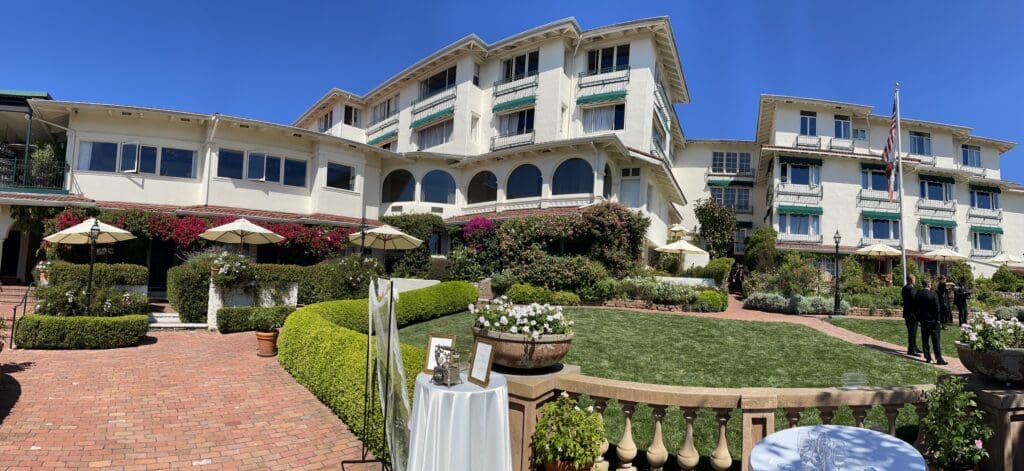
La Playa Hotel offers a different kind of destination wedding experience.
Located in Carmel-by-the-Sea, the historic property combines elegant gardens, distinctive architecture, guest accommodations, and convenient access to the village and nearby coastline.
For couples who want their guests to experience Carmel as more than simply the location of their wedding, this can be a significant advantage.
Guests staying at La Playa or nearby accommodations can enjoy the village’s galleries, restaurants, shops, and coastal scenery without necessarily needing a vehicle for every outing.
The hotel’s gardens and outdoor spaces provide a romantic setting for wedding celebrations, while its indoor event areas offer additional flexibility.
La Playa is especially appealing for couples who appreciate the character of historic hotels.
However, historic properties often have practical differences from modern resorts, and these should be discussed with guests in advance.
La Playa’s older architectural layout deserves particular consideration for guests who have difficulty using stairs. Couples should confirm the accessibility of specific guest rooms and event spaces rather than assuming that every area of the property can be reached in the same way.
Parking is another consideration. Carmel-by-the-Sea is a walkable community, but that doesn’t necessarily mean convenient parking is available everywhere.
Guests arriving by car should receive the hotel’s current parking instructions, particularly during busy weekends.
For those staying elsewhere in Carmel, the proximity of the hotel to the village may make transportation relatively simple. Guests staying in Monterey or Carmel Valley will need to plan for additional travel.
La Playa offers an appealing option for couples who want to combine the atmosphere of a historic coastal hotel with the convenience of a destination where guests can enjoy restaurants, shopping, and the beach during their visit.
From my perspective, this type of location can work particularly well for destination weddings because guests have opportunities to enjoy themselves beyond the scheduled wedding activities.
They can spend the afternoon exploring Carmel, return to their accommodations to prepare, and gather for the celebration without feeling that every part of the weekend requires extensive transportation planning.
Carmel Valley: Vineyards, Ranches, and Warm Inland Hospitality
Carmel Valley offers a distinctly different atmosphere from the coastal communities only a short distance away.
The region is known for its rolling hills, vineyards, ranches, and beautiful countryside. Its inland location often produces warmer daytime temperatures than the nearby coast, particularly during the summer.
Couples are attracted to Carmel Valley for its spacious outdoor venues, scenic estates, and relaxed atmosphere.
However, the distance between accommodations and wedding venues can vary significantly.
A guest staying in Carmel-by-the-Sea may have a relatively straightforward trip to one Carmel Valley property and a considerably longer drive to another farther inland.
The name “Carmel Valley” covers a broad area, and couples should avoid assuming that every venue is close to Carmel Valley Village.
When planning a wedding at a ranch or private estate, transportation deserves particular attention. Some properties have limited parking, long driveways, or access roads that may be unfamiliar to visitors.
Guests should also be prepared for temperature changes between the afternoon ceremony and evening reception.
Carmel Valley Ranch: A Complete Destination Wedding Experience

Carmel Valley Ranch offers something particularly appealing for couples planning a destination wedding: the opportunity to combine a beautiful ceremony and reception with an extended resort experience.
Set across approximately 500 acres in the foothills of the Santa Lucia Mountains, the property features vineyards, oak-covered hillsides, gardens, and a collection of indoor and outdoor event spaces.
Rather than functioning solely as a wedding venue, Carmel Valley Ranch is an established resort with accommodations, dining, golf, spa services, swimming pools, and recreational activities.
For guests traveling from out of town, this can make the wedding weekend feel like a genuine vacation.
One of the property’s advantages is the variety of ceremony and reception locations.
The Vineyard Lawn offers a setting surrounded by Pinot Noir vines, lavender, and mature oak trees, while the Valley Lawn provides expansive hillside views.
Indoor options include the Redwood Room, Oak Room, and Clubhouse, allowing couples to explore different arrangements depending on the size and style of their celebration.
The Organic Garden offers another distinctive environment, particularly for couples who appreciate the region’s agricultural character and farm-to-table culinary experiences.
From a guest perspective, the availability of resort accommodations is particularly valuable.
Guests staying on the property may be able to enjoy much of the wedding weekend without repeatedly traveling between a hotel and the venue.
However, couples should remember that Carmel Valley Ranch is an expansive property.
The distance between guest accommodations, ceremony locations, and reception spaces deserves consideration, especially for older guests or anyone with mobility limitations.
Ask the resort how guests will move between the various locations and what transportation assistance is available.
For families traveling with children, the resort’s recreational offerings may also be appealing. Golf, swimming, outdoor activities, and family-oriented experiences can provide entertainment before or after the wedding.
One consideration is the difference between the resort’s quieter adult-oriented areas and its family recreation facilities. Guests should understand which amenities are available to them and whether reservations or additional charges apply.
For couples who want their wedding to feel like a complete destination experience rather than a single evening celebration, Carmel Valley Ranch offers an appealing combination of natural beauty, accommodations, and activities.
Folktale Winery & Vineyards: A Wine Country Celebration With Distinctive Character

Folktale Winery & Vineyards brings a different atmosphere to Carmel Valley weddings.
Known for its picturesque vineyard setting, European-inspired architecture, wine gardens, and distinctive event spaces, Folktale creates an environment where the setting itself becomes part of the celebration.
For guests visiting from outside the region, a wedding at a winery can provide an experience that feels distinctly Californian.
The surrounding vineyards and hillsides create a relaxed atmosphere, while the property’s event spaces offer opportunities for both intimate gatherings and larger celebrations.
Folktale’s wedding offerings include indoor and outdoor settings, allowing couples to develop an event that reflects their preferences.
One of the most important considerations for destination wedding guests is that Folktale is primarily a winery and event venue rather than a conventional overnight resort.
Couples should therefore make accommodations a separate part of their planning.
Hotels in Carmel Valley, Carmel-by-the-Sea, and Monterey may provide suitable options, depending on availability and the preferences of the guest list.
Transportation also deserves attention.
Guests who plan to enjoy the winery’s beverages should have a dependable way to return to their accommodations.
A coordinated shuttle service may be particularly helpful when many guests are staying at the same hotel.
From an entertainment perspective, winery weddings can create a wonderful progression from an outdoor ceremony to cocktail hour, dinner, and dancing.
However, couples should confirm which event spaces will be used, how guests will move between them, and what restrictions apply to amplified music.
Folktale is an appealing choice for couples who want the atmosphere of Carmel Valley wine country without requiring their guests to travel to an isolated private estate.
Its combination of vineyard scenery, established hospitality, and distinctive architectural character can create a memorable setting for guests who may be experiencing the region for the first time.
Bernardus Lodge & Spa: A Refined Carmel Valley Wedding Retreat
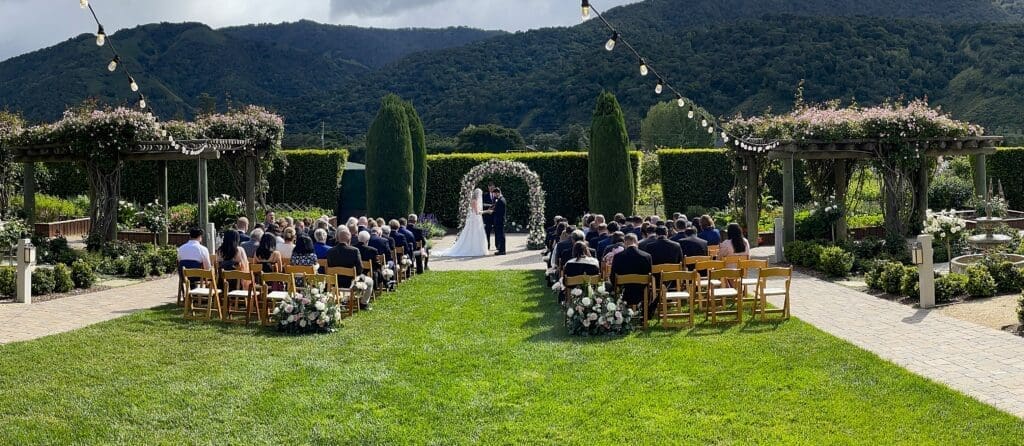
Bernardus Lodge & Spa offers a more intimate luxury resort experience in Carmel Valley, combining elegant accommodations, landscaped gardens, vineyard scenery, and a strong emphasis on hospitality.
The property’s Rose Garden provides a particularly beautiful ceremony setting, with mature oak trees, an expansive lawn, and an impressive collection of roses.
The Meritage Ballroom offers an indoor reception option, while the Harvest Room provides a more intimate setting for smaller gatherings and culinary experiences.
For destination wedding guests, one of Bernardus Lodge’s advantages is the opportunity to stay at a property that feels like a retreat.
Rather than traveling between several locations throughout the wedding weekend, guests who secure accommodations at the lodge may be able to enjoy the ceremony, reception, dining, and resort amenities within the same property.
However, room availability and the cost of accommodations should be discussed early.
Not every guest will necessarily want or be able to book a luxury resort room.
Couples should consider recommending additional hotels in Carmel Valley or nearby communities to accommodate different budgets.
Transportation arrangements should also be considered for guests staying elsewhere.
Bernardus Lodge can be particularly appealing for couples who want a sophisticated celebration with a relaxed wine-country atmosphere.
Its gardens, dining experiences, and resort setting lend themselves to a wedding weekend that emphasizes spending meaningful time with family and friends.
From a guest-experience perspective, the important consideration is balancing the convenience of on-site accommodations with accessible alternatives for guests who prefer to stay elsewhere.
Pebble Beach: Luxury and Beautiful Coastal Scenery

Pebble Beach is associated with dramatic coastal landscapes, celebrated golf courses, and luxurious resort experiences.
Weddings in this area can provide an exceptional setting, particularly for couples who appreciate the region’s natural beauty and upscale hospitality.
However, guests staying outside Pebble Beach should understand how to access the venue, whether specific entrance instructions apply, and how much time to allow for travel.
Properties within the Pebble Beach area may have different arrival procedures, parking arrangements, and access requirements.
Rather than assuming guests will find their way using a general map search, provide the exact venue name, entrance instructions, and recommended arrival time.
For a formal wedding at a resort or private property, it’s also helpful to explain the expected attire and whether portions of the celebration will take place outdoors.
Couples should also consider whether guests will be staying within Pebble Beach or traveling from Carmel, Pacific Grove, or Monterey.
A hotel that appears close on a map may involve a longer trip than expected because of the available road network and property access arrangements.
For guests who enjoy golf, coastal scenery, and fine dining, Pebble Beach can be a wonderful destination. However, accommodations and activities may be priced differently from those in nearby communities, making alternative lodging recommendations especially helpful.
Pacific Grove: Coastal Beauty and a Distinctive Historic Retreat
Pacific Grove offers a quieter coastal atmosphere than some of the region’s busier visitor destinations.
Known for its scenic shoreline, historic neighborhoods, and proximity to Monterey, Pacific Grove can be an appealing location for couples who appreciate natural beauty and a relaxed setting.
Guests staying in the area can enjoy coastal walking paths, restaurants, and nearby attractions while remaining within convenient reach of much of the Monterey Peninsula.
Asilomar Conference Grounds: A Wedding Surrounded by History and Nature
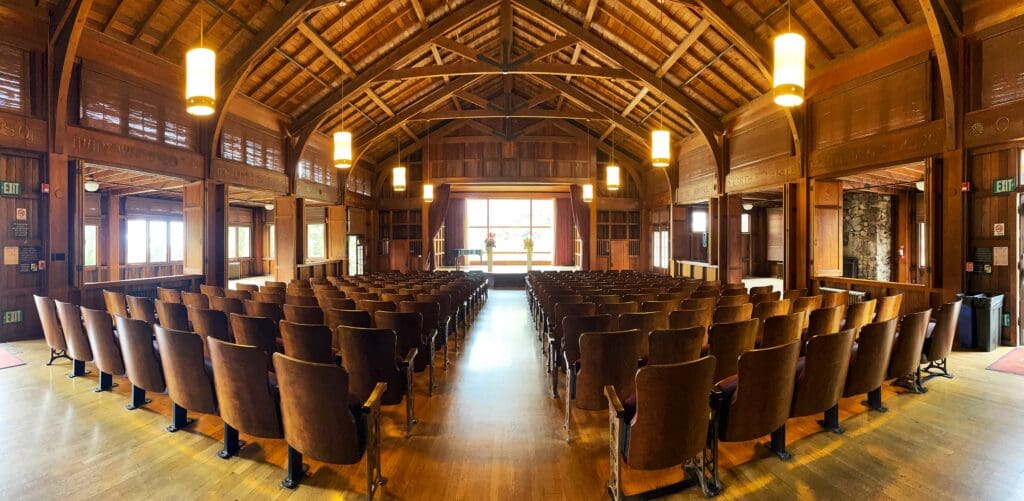
Asilomar Conference Grounds offers one of the most distinctive destination wedding environments on the Monterey Peninsula.
Located in Pacific Grove, the property occupies a beautiful coastal landscape characterized by historic architecture, wooded grounds, open spaces, and proximity to Asilomar State Beach.
The conference grounds were originally developed in the early twentieth century, and several of the historic buildings were designed by renowned architect Julia Morgan.
Unlike a conventional luxury hotel, Asilomar has a character that emphasizes its natural surroundings, historic buildings, and retreat-like atmosphere.
For couples planning a wedding where guests will spend several days together, this can be especially appealing.
One of Asilomar’s advantages is the availability of on-site accommodations.
Guests may be able to stay within the conference grounds, enjoy the surrounding landscape, and participate in wedding activities without repeatedly traveling between distant locations.
The property’s proximity to the coastline also provides opportunities for guests to enjoy scenic walks and the natural beauty of Pacific Grove.
However, couples should understand that Asilomar is a large property with multiple buildings and event spaces.
Guests may need to walk between accommodations, dining facilities, ceremony locations, and reception areas.
For older guests or anyone with mobility limitations, the distance and accessibility of specific routes should be evaluated.
The property’s historic character also means that accommodations and facilities may differ from those found at contemporary resort hotels.
Couples should explain the nature of the property so guests arrive with appropriate expectations.
Asilomar offers wedding packages that can include ceremony and reception furnishings, dining essentials, and other services, but couples should confirm exactly what their selected package provides.
Another important distinction is that Asilomar operates within the California State Parks environment.
Weddings on the conference grounds or associated state beach property are subject to applicable event authorization requirements.
Couples should coordinate with the property’s event staff regarding ceremony locations, sound restrictions, guest access, and any necessary approvals.
Asilomar can be an excellent choice for couples who want a wedding that emphasizes nature, history, and time spent together.
Rather than creating a conventional hotel ballroom experience, the property offers a distinctive setting where the surrounding landscape becomes part of the celebration.
For destination wedding guests, that experience can be particularly memorable when accommodations, walking distances, and event logistics are thoughtfully communicated.
Monterey: Historic Wedding Venues With Convenient Guest Accommodations

Monterey offers a broad selection of hotels, restaurants, waterfront attractions, and visitor services, making it a practical accommodation hub for many destination weddings.
Guests can explore Cannery Row, Old Fisherman’s Wharf, the Monterey Bay Aquarium, and the city’s historic downtown areas while enjoying the coastal atmosphere.
For couples hosting weddings at Monterey hotels, waterfront venues, or nearby properties, keeping guests in the city may simplify transportation and provide more options across different accommodation budgets.
Monterey can also serve as a base for weddings in Carmel, Pebble Beach, and parts of Carmel Valley, although travel time should always be evaluated based on the actual venue and expected traffic.
One advantage of a well-chosen accommodation hub is that guests can socialize outside the wedding itself.
Family members arriving on different days may enjoy breakfast together, explore the waterfront, or gather for an informal evening before the celebration.
These experiences often become some of the most enjoyable memories of a destination wedding weekend.
The Perry House: Historic Elegance in Downtown Monterey

The Perry House offers a wedding experience that combines historic architecture, beautiful gardens, Monterey Bay views, and the convenience of a downtown location.
Originally constructed in the nineteenth century, the property is a distinctive Victorian-style home that has been adapted for private celebrations.
Its historic character creates a setting that feels intimate and personal, while its proximity to downtown Monterey makes it particularly attractive for destination weddings.
One of the property’s greatest advantages is its location.
Guests staying at nearby hotels may be able to walk to the venue, depending on their accommodations and mobility needs.
Restaurants, bars, and other downtown attractions are also nearby.
For couples bringing together guests from several different locations, this can simplify the wedding weekend considerably.
Rather than requiring everyone to travel to a remote property, The Perry House allows guests to experience a historic wedding venue while remaining close to Monterey’s visitor services.
The venue’s garden areas, bay views, and indoor spaces provide opportunities for different portions of the celebration.
Its wedding packages have included catering, bar service, tables, chairs, dinnerware, glassware, linens, and event support, helping couples coordinate many essential reception services through a single venue.
From a guest-experience standpoint, this can reduce the logistical complexity often associated with private-estate weddings.
However, couples should still discuss parking arrangements, accessibility, and the movement of guests between different event spaces.
Historic properties can have unique layouts, and it’s important to understand how those spaces will function for the actual guest count.
For guests who want to continue socializing after the reception, downtown Monterey provides nearby options, although couples should avoid assuming that a particular restaurant or bar can accommodate a large group without advance arrangements.
The Perry House is especially appealing for couples who want a wedding with historic charm and a relaxed atmosphere while keeping their guests close to the conveniences of downtown Monterey.
The Barns at Cooper Molera: A Historic Monterey Wedding With a Distinctive Setting

The Barns at Cooper Molera is another excellent example of a wedding venue that combines historic character with a convenient downtown location.
Situated within Monterey’s historic Cooper Molera property, the venue features beautifully restored barn spaces, gardens, and a setting that reflects the area’s early California heritage.
For couples who appreciate rustic architectural details but don’t necessarily want the logistical challenges of a remote ranch, The Barns offers an interesting alternative.
The property creates the atmosphere of a historic agricultural setting while remaining within downtown Monterey.
Guests can enjoy the distinctive barn environment without having to travel deep into the countryside.
The venue’s wedding experience includes dedicated preparation areas, ceremony and reception spaces, and an established catering and event service operation.
Its published packages have included many of the furnishings and services couples would otherwise need to coordinate separately at a blank-slate property.
From a destination wedding perspective, the downtown location is particularly valuable.
Guests can choose from a variety of Monterey accommodations and enjoy nearby restaurants, attractions, and waterfront activities during their visit.
Couples should still explain the property’s exact entrance and parking arrangements, particularly because historic sites may have different guest and service access points.
Another important consideration is the transition between ceremony, cocktail hour, and reception spaces.
When those transitions are thoughtfully planned, the historic setting can create a wonderful progression throughout the celebration.
As a wedding DJ, I appreciate venues where couples can create distinct experiences for different parts of the evening while maintaining a comfortable flow for guests.
The Barns at Cooper Molera provides that kind of opportunity, with its combination of garden areas, historic architecture, and dedicated event spaces.
For couples seeking a rustic yet refined Monterey wedding, it offers a distinctive setting without requiring guests to navigate the transportation challenges sometimes associated with remote rural venues.
Monterey Beach Station: A Wedding Celebration Directly Along the Coast
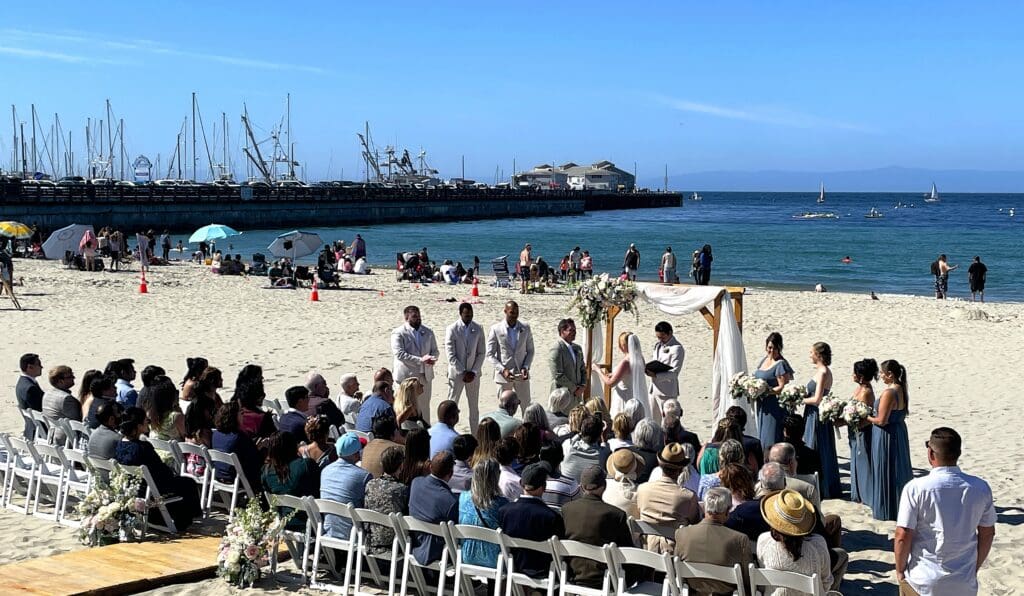
Monterey Beach Station offers a setting that many destination wedding guests immediately associate with California: the Pacific Ocean.
Located along the Monterey waterfront, the venue combines beachside ceremony opportunities with indoor and outdoor reception spaces.
For couples dreaming of exchanging vows with the ocean as their backdrop, the location provides a distinctly coastal atmosphere.
One of the property’s greatest attractions is the opportunity for guests to experience the beach as part of the wedding itself.
Depending on the event arrangements, guests may move from a beach ceremony to an outdoor cocktail area before gathering inside for dinner and dancing.
The venue has also offered beachside fire pits and s’mores experiences as part of its wedding offerings.
These details can create memorable moments, particularly for guests who are visiting the Monterey Peninsula for the first time.
However, coastal weddings require some practical preparation.
Even on sunny days, ocean breezes can make temperatures feel cooler than guests expect.
Couples should encourage appropriate footwear for any ceremony involving sand and recommend layers for outdoor portions of the celebration.
Clear ceremony amplification is also important because surf and wind can interfere with spoken words.
From my perspective as a wedding DJ, outdoor ceremonies near the ocean deserve careful attention to microphone placement and speaker positioning so guests can hear the vows clearly.
Monterey Beach Station’s established wedding packages have included catering, bar service, tables, chairs, linens, dinnerware, glassware, and event coordination services.
Its proximity to downtown Monterey also provides access to numerous accommodations and visitor attractions.
Guests staying at nearby hotels may have a relatively convenient trip to the venue, although walking routes, parking, and transportation should still be confirmed.
For couples who want the beauty of a beach wedding combined with the practical advantages of an established reception venue, Monterey Beach Station offers a distinctive experience.
Big Sur: Extraordinary Beauty With Additional Planning Considerations

Big Sur is one of the most visually spectacular wedding destinations in California.
Its rugged coastline, dramatic cliffs, redwood forests, and secluded properties create an atmosphere unlike almost anywhere else.
For couples dreaming of an intimate destination wedding surrounded by natural beauty, Big Sur can be extraordinary.
However, its remoteness makes careful guest planning especially important.
Highway 1 is a scenic coastal route rather than a conventional high-speed highway. Travel can be slower than guests anticipate, particularly when traffic, road work, weather, or temporary closures affect conditions.
Cellular reception is inconsistent in portions of Big Sur, and navigation services may not always be reliable.
Accommodations are also more limited than in larger nearby communities, making early booking particularly important.
Guests unfamiliar with the area should receive detailed driving directions, information about the availability of parking, and realistic expectations regarding travel.
For some weddings, organized transportation may be the most practical option. For others, nearby lodging and carefully communicated directions may be sufficient.
Couples should also encourage guests to check current road conditions before traveling.
Big Sur’s geography makes transportation planning an essential part of the wedding experience rather than an afterthought.
Alila Ventana Big Sur: An Immersive Luxury Wedding Retreat
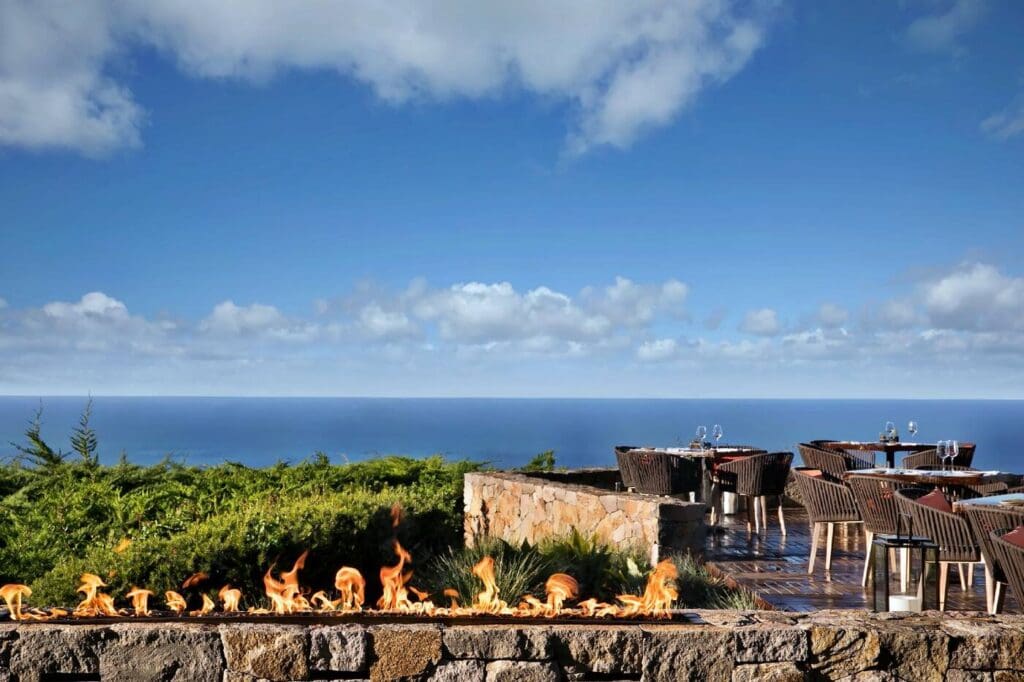
Alila Ventana Big Sur is one of the region’s most distinctive luxury wedding destinations, offering an extraordinary setting where dramatic coastal landscapes meet towering redwoods.
The resort occupies a beautiful property along Highway 1, with event spaces that take advantage of the surrounding mountains, forest, and Pacific Ocean views.
For couples who want a wedding that feels like an exclusive destination retreat, Ventana offers a particularly appealing experience.
Its ceremony and reception locations have included Sur Vista, the Redwood Cathedral, the Ocean Meadow Lawn, and a collection of indoor and outdoor gathering spaces.
These settings allow couples to create different experiences within the same property, from an intimate ceremony overlooking the coastline to a reception surrounded by the natural beauty of Big Sur.
One of the property’s defining characteristics is its luxury accommodation program.
Ventana offers a limited collection of guest rooms and suites, making the resort especially appealing for smaller gatherings and carefully planned wedding weekends.
However, accommodation requirements are an important part of the planning process.
Certain wedding arrangements may require minimum room blocks, and larger celebrations may involve substantial accommodation commitments or property-buyout arrangements.
Couples should review the current wedding agreement carefully and understand the financial responsibilities associated with guest rooms, event spaces, catering, and other services.
Another important consideration is the resort’s location.
Big Sur is beautiful precisely because it feels remote, but that remoteness requires careful transportation planning.
Guests traveling from Monterey, Carmel, or other communities should allow adequate time and review current Highway 1 conditions.
For guests unfamiliar with the region, the drive itself may be a memorable part of the experience, but it shouldn’t be underestimated.
Couples should also consider whether guests will remain on the property throughout the celebration or require transportation back to accommodations elsewhere.
For a luxury destination wedding, having guests stay on-site can create a more relaxed atmosphere and reduce some transportation concerns.
However, not every guest may be able to accommodate the cost of a luxury resort stay.
That reality should be considered when developing the guest list and accommodation arrangements.
From my perspective, Ventana represents the type of venue where the entire wedding experience can become part of a carefully planned getaway.
The scenery, accommodations, dining, and surrounding environment create opportunities for guests to spend meaningful time together beyond the ceremony and reception.
The key is ensuring that the logistical and financial arrangements are clearly understood before invitations are sent.
Loma Vista Gardens: A Historic Big Sur Wedding With Rustic Elegance
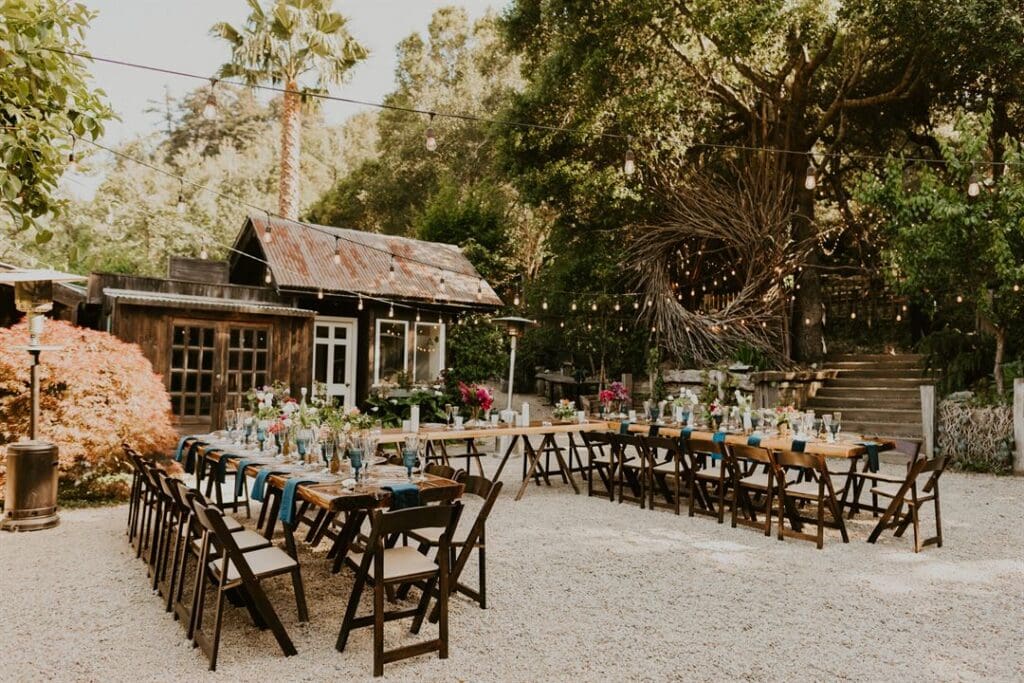
Loma Vista Gardens offers a different kind of Big Sur wedding experience, combining historic character, beautiful gardens, and a setting surrounded by the region’s remarkable natural scenery.
Located along Highway 1 in the Big Sur Valley, the property has a history dating to the early twentieth century.
Its terraced gardens feature a distinctive collection of plants, flowers, and natural landscaping that create an atmosphere both rustic and elegant.
Unlike a conventional resort ballroom, Loma Vista Gardens offers an outdoor environment where the landscape becomes an important part of the wedding.
For couples who appreciate the natural beauty and artistic character of Big Sur, the property provides a particularly distinctive setting.
The gardens and terraced event spaces create opportunities for ceremonies, cocktail gatherings, and receptions that feel integrated with the surrounding environment.
However, the property’s terrain deserves careful consideration.
Terraced gardens can involve changes in elevation, pathways, and movement between different event areas.
Couples should evaluate accessibility and determine whether guests with mobility limitations will require assistance.
Footwear recommendations are also helpful, particularly for guests unfamiliar with outdoor garden venues.
Loma Vista Gardens has offered select accommodations and glamping experiences, but couples should not assume that every guest can stay on-site.
Additional lodging may be necessary, and Big Sur’s limited accommodation inventory makes early planning particularly important.
Transportation is another essential consideration.
Guests should receive detailed directions, realistic travel expectations, and information about parking.
Because cellular reception can be inconsistent in Big Sur, written directions and advance communication can be especially valuable.
Loma Vista Gardens is appealing for couples who want a wedding that reflects the natural and historic character of Big Sur without necessarily choosing a conventional luxury resort experience.
Its gardens, surrounding scenery, and intimate atmosphere can create a memorable celebration, particularly when guest transportation, accessibility, and weather considerations are carefully addressed.
Santa Cruz: Coastal Energy and a Relaxed Wedding Atmosphere
Santa Cruz combines coastal scenery, a lively downtown, beaches, restaurants, and access to the nearby mountains.
For destination wedding guests, the area offers a variety of accommodations and activities, from waterfront experiences to hiking and exploring local communities.
Weddings in Santa Cruz may take place at beachfront properties, historic locations, private estates, or venues in the surrounding countryside.
Travel logistics can vary depending on the exact location.
A venue near downtown Santa Cruz may be convenient for guests staying nearby, while a property in the mountains could require a longer drive along winding roads.
Traffic is another consideration, particularly during popular summer weekends when beach visitors and regional travelers can increase congestion.
Couples should provide realistic travel guidance rather than relying exclusively on the shortest time displayed by a navigation app.
The Grove at Santa Cruz: A Historic Oceanfront Wedding Setting
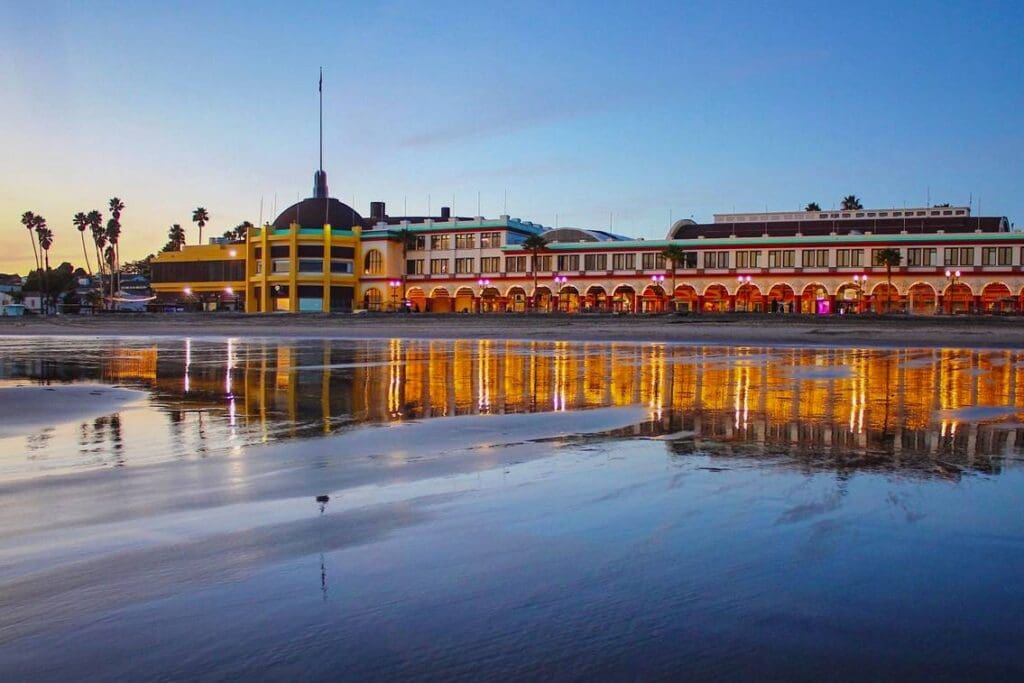
The Grove at the historic Cocoanut Grove in Santa Cruz offers a wedding experience shaped by the city’s coastal character and longstanding entertainment history.
Located at the Santa Cruz Beach Boardwalk, the property features event spaces with views of Monterey Bay.
The historic Cocoanut Grove includes the Grand Ballroom and the glass-domed Sun Room, providing distinctive settings for ceremonies, receptions, and other celebrations.
For couples who want a wedding that feels connected to the energy of Santa Cruz, this location offers a particularly recognizable setting.
Guests can enjoy the surrounding waterfront, beaches, restaurants, and visitor attractions while remaining close to the celebration.
The venue’s location also makes it convenient for guests staying in downtown Santa Cruz or nearby coastal accommodations.
However, couples should remember that the Santa Cruz waterfront can be busy, particularly during weekends, holidays, and popular summer periods.
Parking and traffic deserve careful attention.
Guests should receive clear instructions regarding the correct entrance, available parking facilities, and recommended arrival time.
For weddings during peak visitor periods, allowing additional travel time can help prevent late arrivals.
The historic event spaces also create opportunities for a more traditional ballroom-style reception, which can be particularly appealing to couples who want an established indoor setting near the ocean.
From an entertainment perspective, an indoor ballroom can provide advantages for sound control, lighting, and dancing compared with a completely exposed outdoor reception.
However, couples should still confirm the venue’s specific production requirements, music policies, and event schedule.
For destination wedding guests, The Grove offers an opportunity to combine a formal celebration with the distinctive atmosphere of Santa Cruz’s beachfront community.
Its location can be especially appealing for couples who want their guests to enjoy the surrounding city without traveling to a secluded rural property.
Ben Lomond and the Santa Cruz Mountains: Weddings Among the Redwoods

The Santa Cruz Mountains offer some of the most distinctive wedding settings in Northern California.
Communities such as Ben Lomond and Felton are surrounded by towering redwoods, wooded hillsides, and historic mountain properties.
These environments create an atmosphere that feels wonderfully removed from the activity of nearby coastal cities.
I’ve worked at mountain wedding venues where the natural setting becomes an important part of the entire celebration.
The towering trees, filtered sunlight, and peaceful surroundings can make an outdoor ceremony especially memorable.
However, mountain weddings introduce considerations that couples should address before guests arrive.
Roads may be narrow or winding, parking can be limited, and cellular reception may be inconsistent.
Some properties have uneven terrain, gravel pathways, or significant distances between event areas.
Temperatures beneath the redwoods can also feel noticeably cooler than those in sunny coastal or inland locations.
For guests unfamiliar with the Santa Cruz Mountains, clear directions and practical information can make a tremendous difference.
A wedding website that includes the exact venue address, parking instructions, transportation options, and recommended clothing can prevent confusion and help everyone arrive prepared.
Waterfall Lodge & Retreat: A Wedding Weekend Beneath the Redwoods

Waterfall Lodge & Retreat offers a wedding experience that feels distinctly different from the coastal hotels and wine-country resorts of Monterey County.
Located in Ben Lomond, the property is surrounded by the natural beauty of the Santa Cruz Mountains, with towering redwoods, wooded grounds, cabins, and gathering spaces that create a secluded retreat atmosphere.
For couples who want to spend an extended period with family and friends, this type of setting can be particularly appealing.
Rather than bringing everyone together for only a few hours, the property provides an opportunity for guests to enjoy the mountain environment and participate in a celebration that feels more like a shared getaway.
Waterfall Lodge features a collection of cabins and cottages, along with a lodge and outdoor gathering areas.
On-site accommodations can be particularly valuable for close family members and wedding party participants who want to remain near the celebration.
However, couples should not assume that every guest can stay on the property.
The number of available accommodations is limited relative to the size of some weddings, so additional lodging recommendations may be necessary.
Guests staying in Ben Lomond, Felton, Scotts Valley, or Santa Cruz should receive clear directions and realistic travel guidance.
Mountain roads can be unfamiliar to visitors, particularly after dark.
Another important consideration is the property’s natural terrain.
Redwood venues often feature wooded pathways, grassy areas, and spaces separated by some distance.
Guests should understand what to expect and whether assistance is available for anyone with mobility limitations.
Waterfall Lodge also provides flexibility in selecting outside wedding vendors, allowing couples to personalize many aspects of their celebration.
That flexibility can be appealing, but it makes professional coordination particularly important.
Couples should discuss catering arrangements, transportation, parking, sound restrictions, and the event timeline with the venue before finalizing their plans.
From an entertainment perspective, mountain weddings can create extraordinary atmospheres.
The redwoods provide a beautiful ceremony backdrop, and the secluded setting can make the reception feel wonderfully personal.
However, outdoor sound and reception logistics require careful consideration.
The venue’s policies regarding amplified music, indoor and outdoor entertainment areas, and ending times should be established early so the celebration can be planned accordingly.
Waterfall Lodge is particularly appealing for couples who value the experience of bringing people together in a natural setting and want their wedding to feel like an extended gathering rather than a conventional hotel event.
The Sequoia Retreat Center: An Intimate Celebration Surrounded by Nature
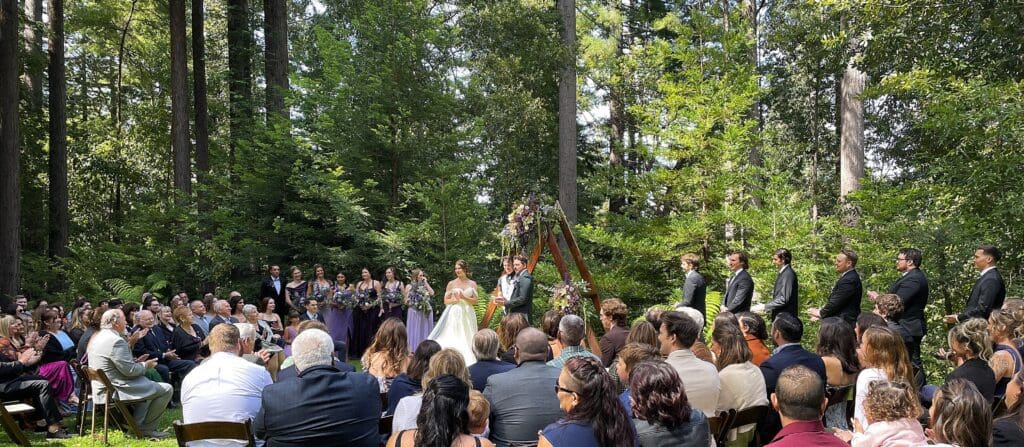
The Sequoia Retreat Center, also located in Ben Lomond, offers another distinctive approach to a redwood wedding.
The property emphasizes the natural beauty of the Santa Cruz Mountains, with wooded ceremony spaces, rustic buildings, and gathering areas designed to complement the surrounding forest.
Among its event locations are Peace Park, a peaceful outdoor ceremony setting; Las Alas Lodge, which provides space for gatherings and dancing; and Pixie’s Garden, an outdoor area suited to dining and celebrations.
The property has also offered smaller cabins and preparation spaces, including ZaZen and Alba Vista.
For couples seeking a wedding that feels intimate, personal, and connected to nature, these settings provide considerable appeal.
One of the most important guest considerations is understanding the layout of the property.
Moving between outdoor ceremony spaces, reception areas, and accommodations may involve wooded pathways and changes in terrain.
Guests should receive practical information about footwear, weather, and accessibility.
The Sequoia also offers limited overnight accommodations, making it important to distinguish between guests who will stay on the property and those who will need nearby lodging.
For couples inviting a larger group, hotels and other accommodations in surrounding communities may be necessary.
Transportation planning should account for the mountain location, particularly when guests are unfamiliar with the roads.
The Sequoia’s wedding arrangements have included furnishings and certain event amenities, while couples retain flexibility in selecting professional vendors.
The venue has required a wedding coordinator or planner, which can be especially valuable at a property where the ceremony, dinner, and reception may take place in different areas.
One detail worth addressing early is the music schedule.
The property’s published wedding information has specified an earlier ending time for dance music than the overall event reservation period.
This is a good example of why couples should distinguish between the time guests may remain on a property and the time amplified entertainment must conclude.
An experienced DJ and Master of Ceremonies can help structure the reception so dinner, toasts, special dances, and open dancing fit comfortably within the available time.
For couples who appreciate the quiet beauty of the redwoods and want a celebration that feels connected to the natural environment, The Sequoia Retreat Center provides a distinctive destination wedding experience.
Fern River Resort: A Relaxed Wedding Getaway Along the San Lorenzo River
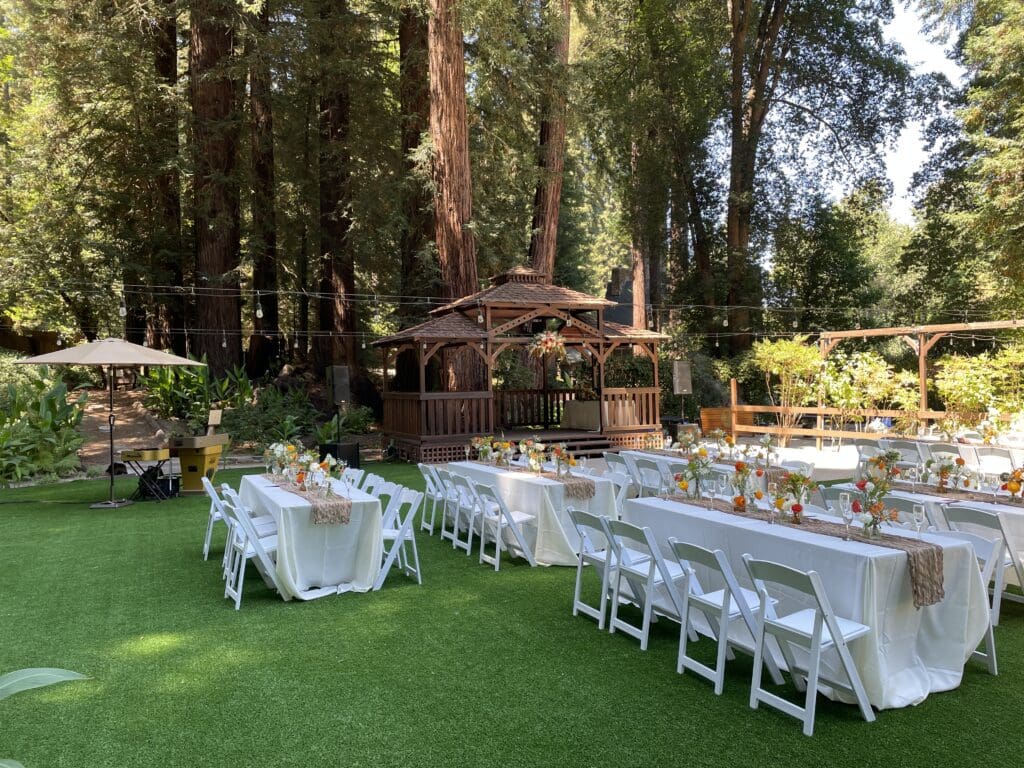
Fern River Resort in Felton offers a wedding environment that combines redwood scenery, cabin accommodations, and the relaxed atmosphere of a mountain getaway.
Located along Highway 9 in the San Lorenzo Valley, the property is surrounded by towering trees and the natural beauty of the Santa Cruz Mountains.
One of its most appealing features for destination weddings is the availability of on-site cabins.
The resort’s wedding information has described 15 cabins of varying sizes, allowing a portion of the wedding party and close family members to stay together.
For couples who want a more casual, extended celebration, this can create opportunities for guests to spend time together before and after the wedding.
The property features several ceremony and gathering locations, including a redwood gazebo, garden areas, and a river overlook.
These spaces create a setting that feels connected to the surrounding forest while providing flexibility in arranging the different portions of the celebration.
From a guest-experience perspective, the combination of lodging and event spaces can simplify certain aspects of the wedding weekend.
However, couples should evaluate how many guests can actually be accommodated on-site and make additional lodging recommendations when necessary.
Fern River Resort is relatively close to Santa Cruz compared with more remote mountain destinations, providing opportunities for guests to enjoy both the redwoods and the coast during their visit.
Another consideration is the property’s reception schedule and music restrictions.
The resort has published guidelines regarding amplified music, outside vendors, and the use of its facilities.
Couples should review those policies carefully and coordinate with their entertainment provider and planner.
For guests who enjoy nature, Fern River Resort’s outdoor gathering spaces and recreational atmosphere can make the wedding weekend feel relaxed and informal.
It’s an appealing option for couples who want the charm of a redwood wedding without necessarily creating a highly formal resort experience.
As with other mountain venues, clear directions, appropriate footwear, transportation arrangements, and information about evening temperatures will help guests arrive prepared.
3. Choosing the Right Hotel Accommodations for Your Wedding Guests

Once you’ve selected your wedding venue, one of the most helpful things you can do is research accommodations for the people traveling to celebrate with you.
For many destination weddings, lodging is one of the largest expenses guests will incur.
Depending on where they’re traveling from, they may also be purchasing airline tickets, renting vehicles, and taking several days away from work.
Providing thoughtful accommodation recommendations demonstrates that you appreciate the effort they’re making to attend your wedding.
However, recommending hotels involves more than simply finding properties close to your venue.
Offer Accommodations at Several Price Points
Not every guest has the same travel budget.
Some may enjoy staying at a luxury coastal resort, while others prefer a comfortable, moderately priced hotel that allows them to spend more on activities during their visit.
Whenever possible, provide two or three accommodation options representing different price ranges.
For example, a couple hosting a wedding in Pebble Beach might recommend an upscale resort for guests seeking a luxury experience, along with additional accommodations in Monterey or nearby communities.
A couple getting married in Carmel Valley could offer suggestions in Carmel Valley Village, Carmel-by-the-Sea, and Monterey, depending on the location of their venue.
For a wedding near Ben Lomond, accommodations in the San Lorenzo Valley may appeal to guests who want to stay close to the mountains, while hotels in Santa Cruz or Scotts Valley could provide additional choices.
The important thing is to explain the practical differences between these options.
A lower nightly hotel rate isn’t necessarily a better value if guests must spend considerably more on transportation.
Similarly, an expensive hotel within walking distance of the reception might eliminate the need for a rental car or late-night transportation.
Encourage guests to compare the complete cost of their stay.
Choosing Accommodations Based on Your Wedding Venue
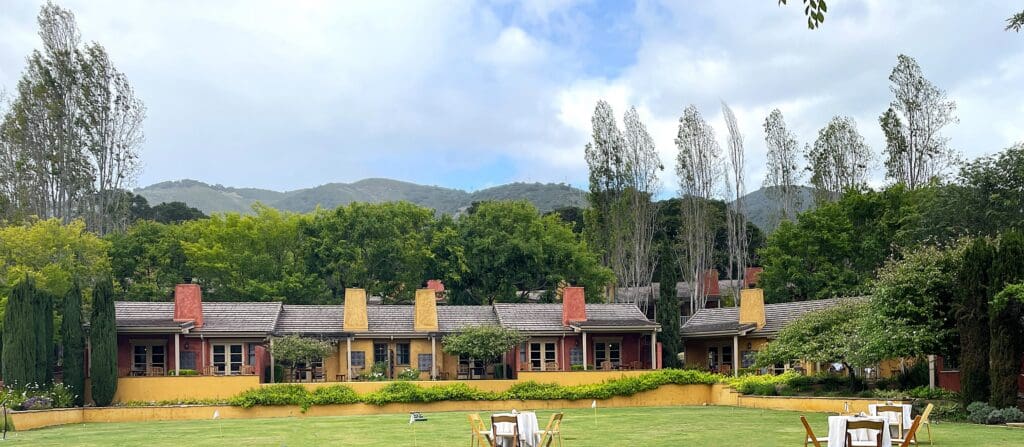
One of the most useful decisions couples can make is selecting a convenient accommodation area before recommending individual hotels.
The right choice depends on the location of the wedding, the number of guests traveling from out of town, and whether the venue provides accommodations of its own.
For weddings at Carmel Valley Ranch or Bernardus Lodge & Spa, on-site lodging can be particularly convenient.
Guests who stay at the resort may be able to enjoy much of the wedding weekend without arranging additional transportation.
However, couples should still provide alternative recommendations for guests who prefer a different accommodation budget.
For weddings at Folktale Winery, Carmel Valley Village, Carmel-by-the-Sea, and Monterey are all worth considering as accommodation areas, although the actual distance and driving route should be evaluated.
Mission Ranch and La Playa Hotel offer a different situation because they’re located within Carmel-by-the-Sea.
Guests may appreciate staying within the village, where restaurants, galleries, and coastal attractions are relatively close together.
At Mission Ranch, the limited number of available guest rooms makes alternative accommodations especially important.
For weddings at Asilomar Conference Grounds, couples should consider the property’s own accommodations along with additional options in Pacific Grove and Monterey.
The Perry House, The Barns at Cooper Molera, and Monterey Beach Station benefit from their proximity to Monterey’s hotel inventory.
These properties may be especially convenient for destination wedding guests who want to explore the waterfront and surrounding attractions.
For Waterfall Lodge & Retreat, The Sequoia Retreat Center, and Fern River Resort, on-site accommodations can help create a shared mountain getaway.
However, the number of available rooms or cabins may be smaller than the wedding guest list.
Additional lodging in Ben Lomond, Felton, Scotts Valley, or Santa Cruz may therefore be necessary.
For The Grove in Santa Cruz, downtown and beachfront accommodations can provide convenient access to the wedding and nearby attractions.
Big Sur requires a particularly thoughtful approach.
Couples planning weddings at Alila Ventana Big Sur or Loma Vista Gardens should consider accommodation availability early, particularly because the region has fewer lodging options than Monterey or Santa Cruz.
A hotel that appears relatively close on a map may still involve a substantial drive along Highway 1.
The most important lesson is to avoid recommending accommodations based exclusively on the lowest nightly rate.
A hotel that’s less expensive but inconveniently located can create additional transportation costs and unnecessary stress for your guests.
Understanding Wedding Hotel Room Blocks
A hotel room block is an arrangement in which a hotel sets aside or offers a designated number of rooms for guests attending a particular event.
Depending on the property, the arrangement may provide a negotiated rate, a convenient booking process, or a designated inventory of rooms.
However, hotel blocks aren’t all structured the same way.
Some are courtesy blocks, where rooms are offered without requiring the couple to guarantee that every room will be booked.
Others involve contractual commitments that may create financial obligations if a specified number of rooms remain unused.
This distinction deserves careful attention.
Before signing a room-block agreement, ask whether the arrangement includes minimum booking requirements, cancellation penalties, deposits, or attrition clauses.
An attrition clause can require the contracting party to pay for some portion of rooms that guests don’t ultimately reserve.
Couples should also confirm the reservation cutoff date.
Hotels typically release unused rooms from the block after a specified deadline, although the precise terms vary.
Don’t assume that every guest will book through your designated hotel.
Some may use loyalty points, stay with relatives, reserve vacation rentals, or choose accommodations that better suit their personal preferences.
Don’t Overlook Vacation Rentals
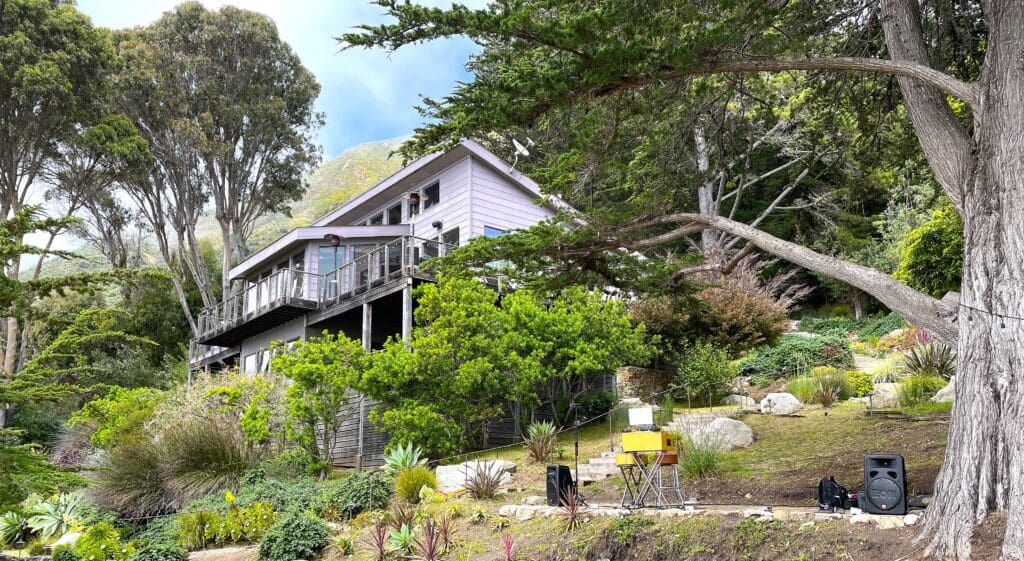
Vacation homes can be attractive for larger families or groups of friends who want to stay together.
A multi-bedroom rental may provide shared living areas, kitchen facilities, and additional flexibility.
However, vacation rentals introduce considerations that conventional hotels generally handle differently.
Guests should review cleaning fees, parking limitations, cancellation policies, occupancy restrictions, and check-in procedures.
Some properties prohibit parties, gatherings, or additional visitors beyond the registered occupants.
Couples should never assume that a vacation rental can double as a rehearsal dinner location or informal wedding gathering without the owner’s permission.
Vacation rentals can be especially appealing in Carmel Valley and the Santa Cruz Mountains, but guests should also consider the property’s accessibility and distance from the wedding venue.
Make the Hotel Booking Process Simple
Rather than providing a long directory of accommodations, select a manageable number of recommendations and include useful details.
For each property, identify its location, approximate travel relationship to the wedding venue, reservation instructions, and any applicable group booking information.
If a hotel has provided a special booking link or group code, include it directly on your wedding website.
Also explain whether transportation will be provided from that property.
One particularly helpful detail is the distinction between a hotel being recommended and a hotel being served by a wedding shuttle.
Guests may reasonably assume that transportation is available from every hotel listed on the wedding website unless the couple makes that distinction clear.
On-Site Wedding Weekends Versus Single-Day Celebrations
These Central Coast venues illustrate two different approaches to destination wedding planning.
Properties such as Carmel Valley Ranch, Bernardus Lodge & Spa, Asilomar Conference Grounds, Waterfall Lodge & Retreat, Fern River Resort, and Alila Ventana Big Sur offer opportunities to combine the wedding with overnight accommodations.
Depending on the property, couples may be able to arrange welcome gatherings, rehearsal dinners, recreational activities, and farewell events without requiring guests to travel between several locations.
This can create a wonderful sense of togetherness.
Family members who haven’t seen one another in years may spend an entire weekend reconnecting.
Friends traveling from different parts of the country can enjoy the destination together, and the couple may have more opportunities for meaningful conversations than a conventional reception schedule allows.
However, an on-site wedding weekend isn’t necessarily the best choice for every guest list.
Some guests may prefer the flexibility of choosing their own accommodations.
Others may have limited vacation time or need to return home immediately after the celebration.
A single-day wedding at a conveniently located venue such as The Perry House, The Barns at Cooper Molera, Monterey Beach Station, or The Grove can be equally memorable.
The advantage is that guests may have greater flexibility in arranging accommodations and exploring the surrounding community independently.
Neither approach is inherently better.
The right choice depends on the atmosphere the couple wants to create and the practical needs of the people attending.
4. Transportation: One of the Most Important Parts of the Guest Experience
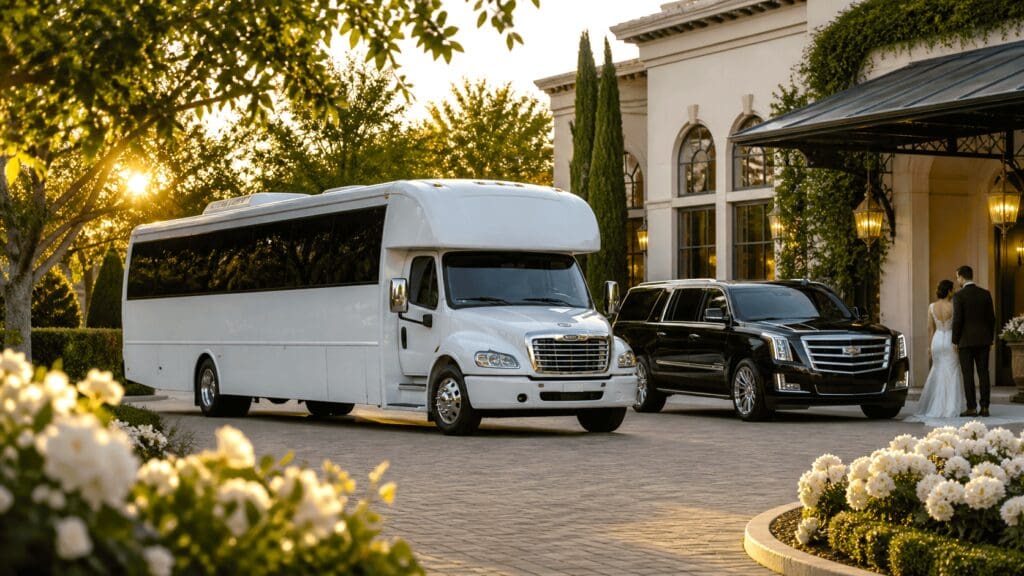
Transportation is one of those wedding details that guests rarely think about when everything works properly, but remember vividly when it doesn’t.
A beautiful ceremony loses some of its magic when guests arrive late, frustrated, or uncertain about where they’re supposed to park.
Likewise, a wonderful reception can end on an uncomfortable note if guests are left struggling to arrange transportation back to their accommodations.
This is particularly important for destination weddings involving rural properties, private estates, and mountain venues.
Should You Provide Wedding Shuttle Transportation?
There isn’t a universal answer.
For a wedding at a hotel where most guests are staying on-site, transportation may be unnecessary.
For a celebration at a remote Big Sur property, Carmel Valley ranch, or secluded Ben Lomond venue, organized transportation can be extremely valuable.
Shuttle service may help reduce parking congestion, simplify arrivals, and provide guests with an alternative to driving after consuming alcohol.
However, transportation arrangements should reflect the actual location and guest list.
A large charter bus may be suitable for some properties but unable to navigate the access roads leading to others.
Smaller vehicles may be necessary for mountain locations or private estates with limited turnaround space.
Before making arrangements, confirm that the transportation company has evaluated the route and can safely access the venue.
Think About Transportation in Both Directions
Couples often focus on getting guests to the ceremony but spend less time considering how everyone will return home.
At the beginning of the wedding, most guests arrive within a relatively narrow time window.
At the end of the reception, departures may be more scattered.
Some guests will want to leave shortly after dinner.
Others may stay until the final dance.
If everyone must use the same shuttle, the transportation schedule should accommodate these different needs whenever practical.
One option is to arrange an earlier departure for guests who prefer not to stay until the end, followed by later departures for those enjoying the dancing.
The schedule should be developed with the transportation company based on vehicle capacity, travel time, and the number of guests requiring service.
A single vehicle may need several trips to transport everyone, particularly when the accommodations are a considerable distance from the venue.
Don’t Assume Rideshare Services Will Be Available
Guests visiting from larger metropolitan areas may be accustomed to opening a rideshare app and finding a driver within minutes.
That expectation isn’t always realistic in rural parts of Monterey County or the Santa Cruz Mountains.
Availability can be inconsistent, especially late at night or at remote properties.
Even when a driver accepts a request, limited reception or an unfamiliar pickup location can complicate the arrangement.
If your wedding is taking place at a remote property, don’t make rideshare availability the foundation of your transportation plan without verifying that the service is practical.
For guests arranging their own transportation, provide information about established local transportation providers when appropriate. From my experience with local ride share at events in the area, I will say that’s it’s very unreliable. I would not count on it as a “Plan A.”
Make Parking Instructions Unmistakably Clear
If guests are driving, explain exactly where they should park.
This may sound obvious, but wedding venues frequently have multiple entrances, private roads, service areas, and parking locations that aren’t immediately apparent to first-time visitors.
Some properties require guests to park at an off-site location and board a shuttle.
Others have designated areas that differ from the entrance used by vendors.
Your wedding website should clearly identify the correct arrival location.
For remote properties, written directions can be especially useful when navigation services or cellular reception are unreliable.
I’ve worked at enough rural weddings to appreciate how easily a small transportation misunderstanding can affect the schedule.
If several guests arrive late because they couldn’t locate the correct entrance, the ceremony may be delayed, which can create a ripple effect throughout the afternoon.
Clear instructions are a relatively simple way to prevent that problem.
Transportation Planning for Coastal, Downtown, and Mountain Venues
After decades of working at weddings throughout the Central Coast, I’ve learned that transportation planning becomes especially important when guests are unfamiliar with the surrounding area.
The requirements can vary dramatically between properties.
A wedding at The Perry House in downtown Monterey may involve relatively straightforward travel from nearby hotels.
A celebration at Waterfall Lodge in Ben Lomond or Loma Vista Gardens in Big Sur may require more detailed directions and additional planning.
For coastal and downtown venues. Couples should focus on parking instructions, hotel locations, pedestrian access, and the possibility of traffic during busy visitor periods.
At Carmel Valley properties. The main considerations may involve the distance between accommodations and the venue, rural access roads, and the availability of transportation after the reception.
For weddings in the Santa Cruz Mountains. Guests should understand that mountain roads may be winding, unfamiliar, and poorly suited to last-minute navigation.
And for Big Sur, current Highway 1 conditions should always be considered, along with the possibility of limited cellular reception.
One recommendation I make for remote weddings is to provide guests with written driving instructions in addition to a map.
A navigation app can be extremely useful, but it shouldn’t be the only source of information when the venue is located in an area with unreliable reception.
Couples should also consider whether transportation will be available for guests who prefer not to drive after the reception.
A beautiful destination wedding should conclude with guests returning safely and comfortably to their accommodations.
5. The Wedding Timeline Should Consider the Guest Experience
As a wedding DJ and Master of Ceremonies, reception timelines are a significant part of my work.
Over the years, I’ve seen beautifully planned weddings where everything flows naturally, and I’ve also witnessed celebrations where unnecessary gaps, rushed transitions, or poorly coordinated activities affect the atmosphere.
A wedding timeline shouldn’t be designed exclusively around the couple’s formal activities.
It should also consider how guests will experience the day.
Avoid Asking Guests to Arrive Unnecessarily Early
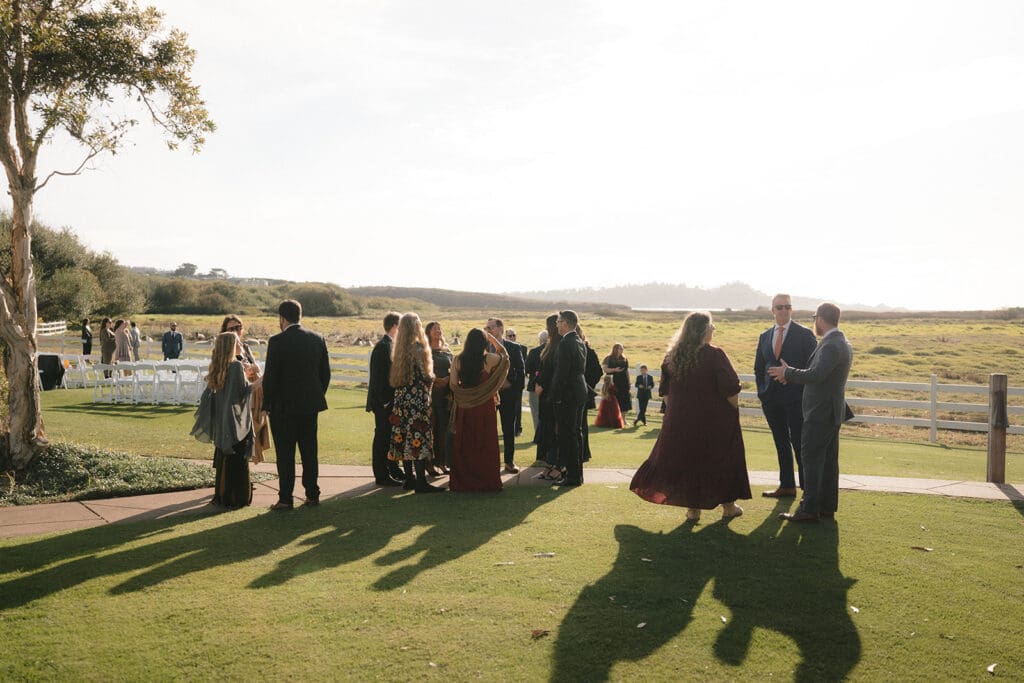
Couples understandably want everyone seated before the ceremony begins.
However, asking guests to arrive excessively early can create unnecessary waiting, particularly at outdoor venues without adequate seating, shade, or shelter.
For a conventional ceremony with convenient parking, an arrival window of approximately 20 to 30 minutes before the scheduled start may be appropriate.
For remote properties with shuttle transportation, the necessary arrival window may be longer.
The correct timing depends on the venue, transportation arrangements, and number of guests.
The objective is to allow enough time for comfortable arrivals without leaving people standing around for an extended period.
Consider What Happens Between the Ceremony and Reception
One of the most common challenges at weddings involving multiple locations is the transition from the ceremony to the reception.
If the ceremony concludes at 4:00 p.m. but the reception doesn’t begin until 6:30 p.m., what are guests expected to do during that time?
At a resort or hotel, they may have access to a lounge, restaurant, or comfortable waiting area.
At a remote ranch or mountain property, they may have few options.
Long gaps can be especially inconvenient for guests who are unfamiliar with the area or don’t have their own transportation.
Whenever possible, I prefer timelines that allow the celebration to move naturally from one experience to the next.
A ceremony followed by a well-organized cocktail hour provides an opportunity for the couple to take photographs while guests enjoy refreshments, conversation, and background music.
Cocktail Hour Is More Important Than Many Couples Realize
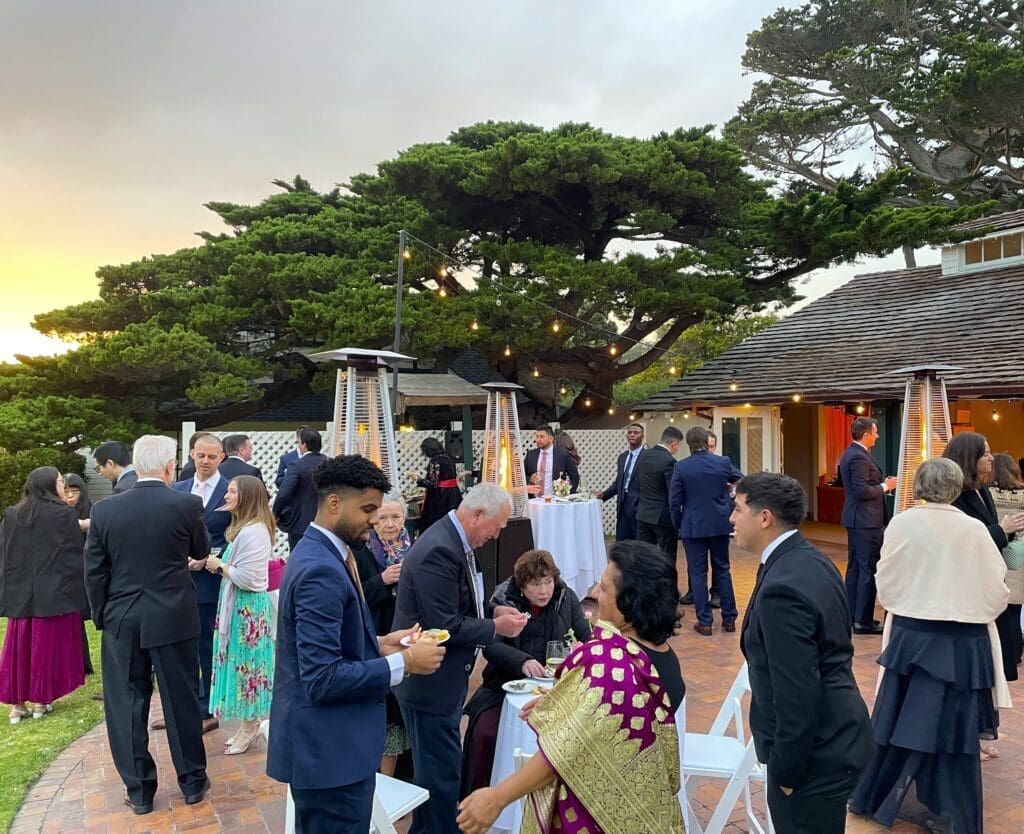
Cocktail hour serves a practical purpose, but it’s also an important part of the overall guest experience.
After the ceremony, people are ready to relax, reconnect with friends, and begin celebrating.
A comfortable cocktail area with adequate seating, refreshments, appetizers, and thoughtfully selected music can establish a wonderful atmosphere for the rest of the evening.
From an entertainment perspective, cocktail hour is an opportunity to create a welcoming musical environment without competing with conversation.
The music should complement the setting and the couple’s preferences.
A coastal wedding might feature relaxed contemporary music, classic jazz, or acoustic selections.
A multicultural wedding might incorporate music that reflects the backgrounds of the couple and their families.
The possibilities are nearly endless.
However, the practical details are just as important as the soundtrack.
Are there enough places for guests to sit?
Is the bar accessible?
Are appetizers being circulated efficiently?
Can guests comfortably hear one another?
A well-designed cocktail hour makes the transition into dinner feel effortless.
Keep Guests Informed Without Overwhelming Them
One of the responsibilities I take seriously as a Master of Ceremonies is helping guests understand what’s happening throughout the reception.
Announcements should be clear, professional, and appropriately timed.
Guests don’t need a running commentary on every detail of the evening, but they should know when dinner is beginning, when important activities are taking place, and when they’re invited to join the celebration on the dance floor.
A smooth, well-spoken Master of Ceremonies can help maintain the event’s momentum without resorting to unnecessary gimmicks or constant interruptions.
Good communication is especially valuable at destination weddings because guests may be unfamiliar with the property or the planned sequence of events.
Avoid Letting the Formalities Consume the Entire Reception

A wedding reception can include introductions, a first dance, parent dances, toasts, dinner, cake cutting, and other meaningful traditions.
Each deserves thoughtful consideration.
However, scheduling too many activities without accounting for their combined duration can leave surprisingly little time for guests to socialize and dance.
This becomes particularly important at venues with early music curfews.
For example, a wedding at a rural property where amplified music must end at 9:00 p.m. may require a different reception schedule from one at a hotel where dancing can continue later.
The key is to prioritize the activities that matter most and arrange them in a way that keeps the celebration moving.
Guests generally appreciate a reception that feels organized without feeling rigid.
Creating a Reception Timeline That Works With the Venue
The layout of a venue can influence the timeline just as much as the couple’s preferred activities.
A resort with several event spaces may allow couples to host the ceremony, cocktail hour, dinner, and dancing in different locations.
This can create a wonderful progression throughout the celebration, but each transition requires coordination.
At Carmel Valley Ranch, the movement between outdoor lawns, terraces, and indoor reception spaces should be carefully planned.
At Asilomar, the distance between different buildings and event areas may influence the time required for guests to move from one activity to another.
And at The Sequoia Retreat Center, the property’s published music restrictions make it especially important to schedule dinner, speeches, special dances, and open dancing within the permitted entertainment window.
For a wedding at Monterey Beach Station, the transition from a beach ceremony to cocktail hour and an indoor reception can create a beautiful flow when the timing is coordinated properly.
At historic properties such as Mission Ranch, The Perry House, and The Barns at Cooper Molera, couples should discuss the movement between ceremony, cocktail, dining, and dancing areas with their planner and entertainment provider.
As a professional DJ and Master of Ceremonies, I believe these transitions deserve as much attention as the formal activities themselves.
Guests shouldn’t feel as though they’re being hurried from one location to another, but they also shouldn’t be left wondering where they’re supposed to go next.
A well-developed timeline allows the entire celebration to unfold naturally.
6. Guest Comfort: The Details That Make a Remarkable Difference
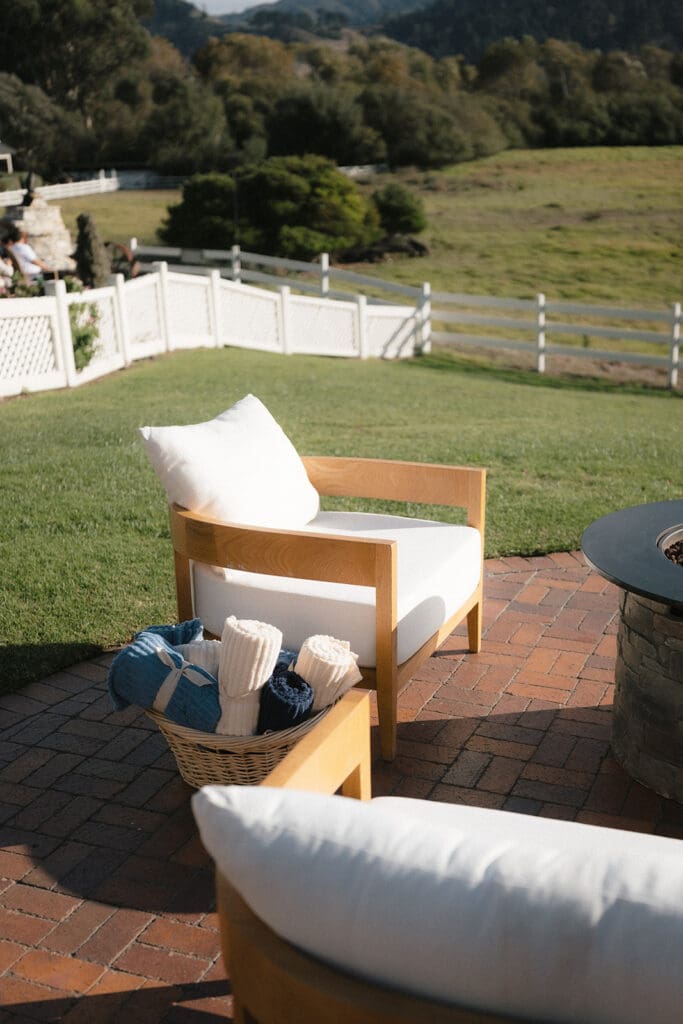
Wedding guests may not remember the exact color of your table linens or the style of your charger plates, but they’re likely to remember whether they were comfortable throughout the celebration.
This doesn’t mean every wedding needs luxurious accommodations or elaborate amenities.
Often, relatively simple decisions make the greatest difference.
Prepare Guests for the Central Coast’s Microclimates
One of the most distinctive characteristics of this region is the variation in weather between neighboring communities.
A summer afternoon in Carmel Valley may be sunny and warm, while guests arriving from Monterey experience cool coastal fog.
A ceremony overlooking the ocean in Big Sur can feel considerably cooler and windier than an inland celebration.
Beneath the redwoods near Ben Lomond, shaded conditions may create a different experience from nearby open areas.
These differences can catch out-of-town guests by surprise.
Someone traveling from a hot inland city might assume that a California summer wedding means warm temperatures throughout the evening.
A guest arriving in lightweight formal attire may discover that a coastal reception becomes chilly after sunset.
Help guests prepare by explaining the expected conditions and recommending layers when appropriate.
A simple note on your wedding website can prevent considerable discomfort.
Explain the Terrain and Footwear Considerations
Outdoor wedding venues often include lawns, gravel pathways, wooden decks, stone patios, and other surfaces that may not be ideal for every type of footwear.
If guests will be walking across grass or uneven terrain, mention it in advance.
For a redwood wedding with wooded pathways, practical footwear may be especially important.
This doesn’t mean guests need to abandon formal attire.
It simply gives them the information necessary to make appropriate choices.
Someone planning to wear narrow high heels may appreciate knowing that the ceremony will take place on a lawn rather than a paved terrace.
At properties such as Loma Vista Gardens, The Sequoia Retreat Center, Waterfall Lodge, and Fern River Resort, the natural landscape is part of the experience.
Guests should know whether they’ll be navigating gardens, wooded pathways, or uneven surfaces.
Provide Adequate Seating Throughout the Celebration

Reception seating is usually planned carefully because everyone needs a place during dinner.
Ceremony and cocktail-hour seating sometimes receive less attention.
For an outdoor ceremony, consider whether older guests, pregnant guests, or anyone with mobility limitations will have convenient access to comfortable seating.
During cocktail hour, a mix of standing tables and seated areas can help accommodate different preferences.
Not everyone wants to stand for an hour while enjoying appetizers and conversation.
If your venue has a large outdoor space, make sure seating isn’t concentrated so far from the main gathering area that guests feel disconnected from the celebration.
Consider Shade, Heating, and Lighting

Guest comfort also depends on environmental conditions.
An outdoor ceremony during a warm afternoon may require shade or access to drinking water.
A cool evening reception may benefit from patio heaters or a sheltered gathering area.
At rural properties, adequate lighting becomes especially important after sunset.
Paths between the reception area, restrooms, parking, and other facilities should be safely illuminated.
Decorative string lighting can create a beautiful atmosphere, but it shouldn’t be assumed to provide sufficient visibility for every walkway.
These considerations become particularly important at ranches, private estates, and mountain properties where permanent outdoor lighting may be limited.
Don’t Forget About Accessibility
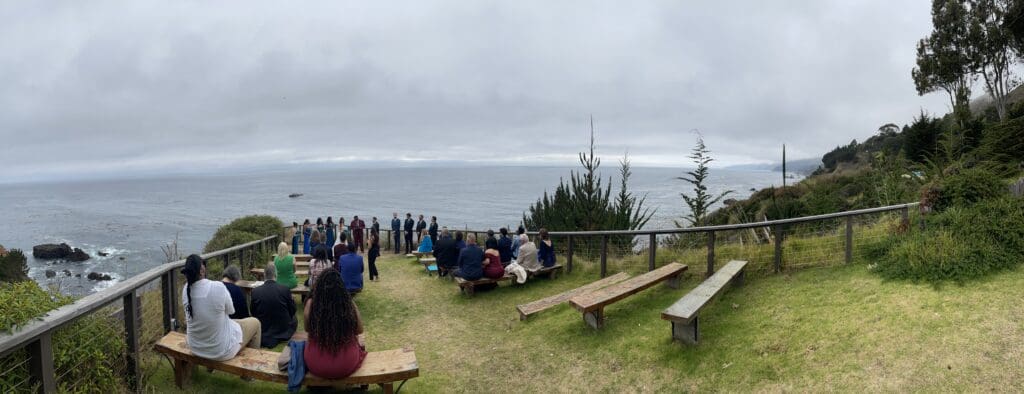
Accessibility should be considered during venue selection, not treated as an issue to solve after invitations have been sent.
A property may have an accessible main entrance but still present challenges involving ceremony lawns, gravel pathways, restrooms, or transportation between event spaces.
Ask the venue about accessible routes, restroom facilities, parking, and any areas where assistance may be necessary.
For guests who use wheelchairs, walkers, or other mobility aids, even relatively short distances can become difficult when the terrain is uneven.
It’s also worth considering guests who have difficulty standing for extended periods or navigating stairs.
Rather than making assumptions about what someone needs, communicate privately and respectfully with guests who may require accommodations.
A thoughtful solution might involve accessible transportation, conveniently located seating, or an alternate route between event areas.
The objective is simple: everyone invited to celebrate should have a meaningful opportunity to participate comfortably.
7. Planning for Guests Traveling With Children
Children can bring tremendous joy and personality to a wedding celebration.
They can also introduce practical considerations that are easy to overlook when most of the planning focuses on adults.
If you’re inviting families with young children, think about the experience from the parents’ perspective.
Traveling to a destination wedding may involve car seats, strollers, extra luggage, different sleeping arrangements, and adjustments to familiar routines.
A little advance information can make the experience much easier.
Make Your Invitation Policy Clear
The first consideration is whether children are invited.
Some couples envision a family-friendly celebration where children are welcome throughout the day.
Others prefer an adults-only wedding.
Both approaches are perfectly reasonable.
What matters is communicating your decision clearly and early enough for parents to make arrangements.
If your wedding is adults-only, don’t assume that guests will automatically understand this from the names printed on the invitation.
A polite explanation on your wedding website can eliminate confusion.
For destination weddings, the decision may affect whether parents can attend at all, particularly if they’re traveling a considerable distance from home.
Giving guests adequate notice allows them to evaluate their options.
Childcare Considerations
Some couples choose to arrange childcare for guests attending an adults-only destination wedding.
Others provide recommendations for local childcare services without organizing the service themselves.
If you decide to offer childcare, use appropriately qualified providers and confirm the arrangements, insurance, supervision, and location.
Avoid placing responsibility for supervising children on wedding vendors whose primary duties involve catering, entertainment, photography, or coordination.
If children are attending the reception, consider whether a quiet area is available for families who need a break from the festivities.
Young children may become tired well before the dancing ends, and parents often appreciate having somewhere comfortable to step away.
Children’s Meals and Seating

Catering companies may offer children’s menus or modified meal options, but these should be confirmed during the planning process.
High chairs, booster seats, and appropriate table arrangements may also need to be requested in advance.
For families with infants, consider whether the venue has a private, comfortable space for feeding or changing.
These details may seem minor, but they can significantly influence how welcome and relaxed parents feel.
Should Children Participate in the Dancing?
Absolutely, when the couple wants a family-friendly reception.
Some of my favorite wedding moments have involved multiple generations sharing the dance floor.
It’s wonderful to see grandparents, parents, and children enjoying music together.
However, a family-friendly reception doesn’t require turning the evening into a children’s party.
An experienced open-format DJ can incorporate music that appeals to different generations while keeping the overall atmosphere appropriate for the couple’s celebration.
The key is understanding the audience and reading the room.
8. Welcoming Guests of Different Ages, Backgrounds, and Abilities

A wedding is one of the few occasions when people from many different parts of a couple’s life gather in one place.
Childhood friends, coworkers, grandparents, cousins, college roommates, and extended family members may all be meeting one another for the first time.
For multicultural and LGBTQ-inclusive weddings, the celebration may also bring together guests with different traditions, languages, cultural expectations, and family experiences.
Creating a welcoming environment means recognizing those differences without making assumptions about what any individual guest wants or needs.
Make Everyone Feel Included
One of the most meaningful aspects of a wedding is the opportunity to celebrate relationships and connections.
Couples should feel comfortable designing a celebration that reflects who they are, rather than following traditions that don’t feel appropriate.
That may involve adapting the processional, selecting inclusive language for introductions, incorporating multiple cultural traditions, or choosing alternatives to conventional wedding activities.
As a Master of Ceremonies, I believe announcements should respect the couple’s preferences and the people attending.
Correct names, thoughtful introductions, and clear communication matter.
For multicultural weddings, it may also be helpful to explain unfamiliar traditions briefly so guests understand the significance of what they’re witnessing.
The objective isn’t to turn the wedding into a formal presentation.
It’s to help everyone feel connected to the celebration.
Consider Multilingual Communication

If a significant number of guests speak different languages, certain information may be more useful when presented in more than one language.
This could include transportation instructions, ceremony programs, welcome materials, or selected reception announcements.
Not every wedding requires a bilingual Master of Ceremonies, but couples should consider whether language differences might affect guests’ understanding of important details.
Even a brief explanation of a cultural tradition or a translated transportation schedule can be appreciated.
Don’t Overlook Hearing and Visual Accessibility
Ceremony sound is especially important for guests who have difficulty hearing.
At outdoor weddings, wind, ocean surf, traffic, and environmental noise can make spoken words difficult to understand without proper amplification.
A professional ceremony sound system helps guests hear the officiant, vows, and readings more clearly.
However, amplification alone may not meet every accessibility need.
Depending on the guest list and venue, couples may wish to explore assisted-listening devices, captioning, interpreters, large-print programs, or other accommodations.
For guests with visual impairments, clear directions, accessible pathways, and assistance navigating unfamiliar properties can be equally important.
Thoughtful planning begins with asking what people need rather than assuming everyone experiences the environment in the same way.
9. Wedding Music and the Guest Experience: Finding the Right Balance

After more than 38 years as a wedding DJ, one thing remains clear to me: music has an extraordinary ability to bring people together.
It can create anticipation before a ceremony, establish a relaxed atmosphere during cocktail hour, add elegance to dinner, and transform a reception into a celebration that guests remember for years.
But creating that experience requires more than selecting popular songs.
Every wedding has its own personality, and every guest list brings a different combination of musical tastes, ages, backgrounds, and expectations.
The challenge is to respect the couple’s preferences while creating an atmosphere that encourages their guests to participate.
Your Wedding Should Reflect Your Musical Tastes
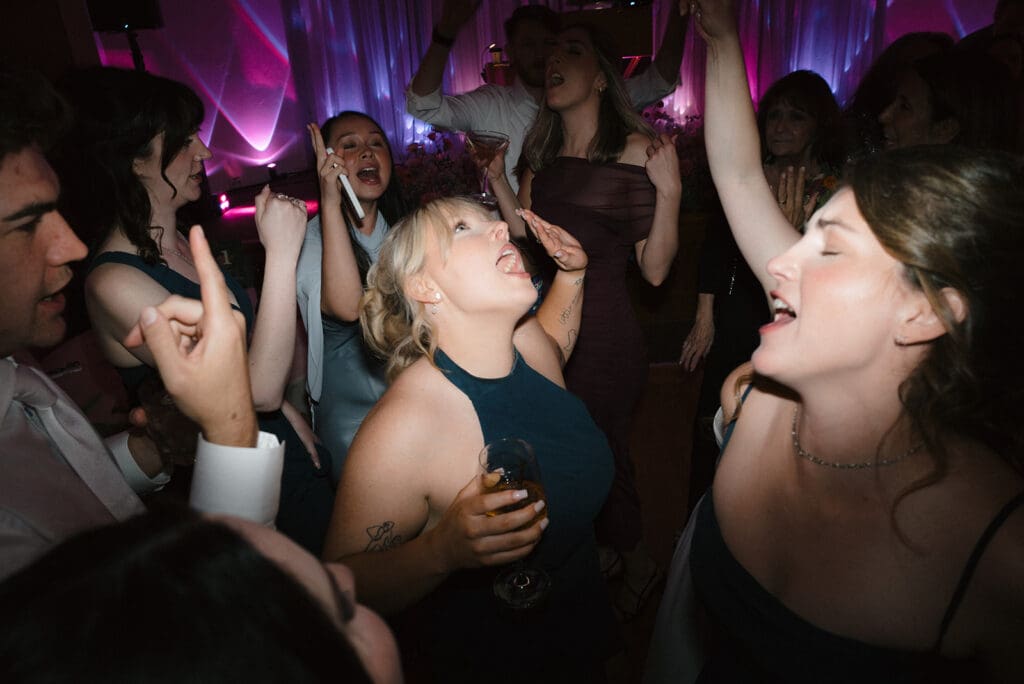
The couple’s preferences should always be the starting point.
Perhaps you love Indie and early 2000’s or country music, classic rock, contemporary pop, Latin music, Bollywood, reggae, or a combination of several genres.
Your wedding doesn’t need to sound like anyone else’s.
However, it’s worth considering how your musical choices will work throughout the different portions of the celebration.
Music during the ceremony serves a different purpose from music during dinner.
The songs that create a wonderful cocktail-hour atmosphere may not be the same selections that energize the dance floor later in the evening.
A thoughtful musical progression helps create a natural rhythm for the day.
Why an Open-Format DJ Can Make a Difference
At many weddings, the guest list includes people whose musical preferences span several generations and cultures.
An open-format DJ has the flexibility to move between genres, recognize what guests are responding to, and adjust the music accordingly.
This is especially valuable at destination weddings where friends and family members may be gathering from different regions and backgrounds.
I’ve worked at receptions where one musical style initially dominated the couple’s preferences, but the guests responded more enthusiastically when additional genres were introduced.
With the couple’s approval and a clear understanding of their musical boundaries, adjusting the selections can transform the atmosphere.
The objective isn’t to ignore the couple’s wishes.
It’s to create the celebration they envisioned while responding intelligently to the people in the room.
Reading the Room Matters More Than Following a Rigid Playlist
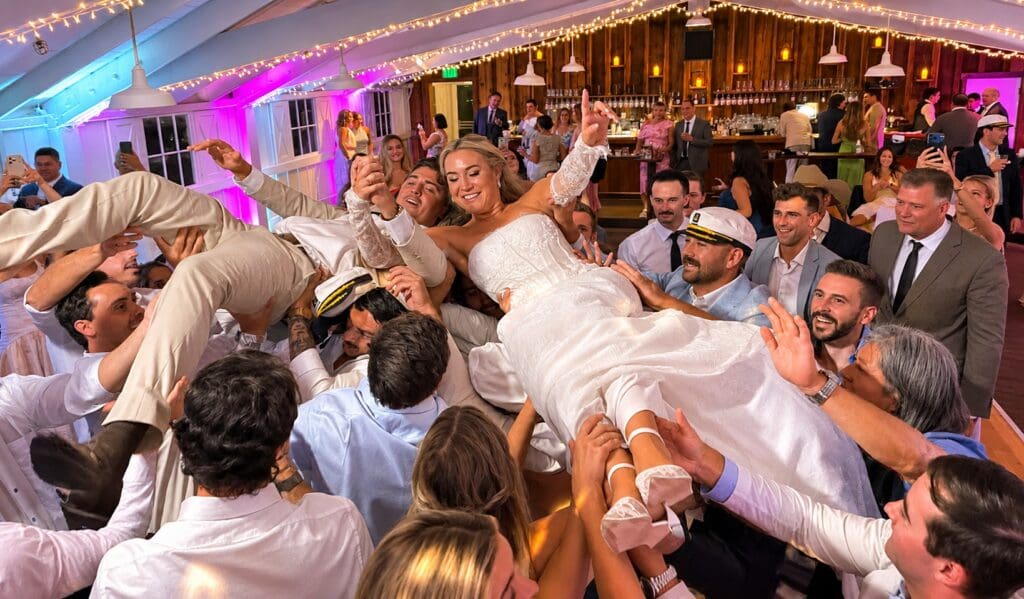
A carefully selected playlist is an important planning tool, but it shouldn’t prevent a professional DJ from responding to the energy of the reception.
If guests are enthusiastically dancing to a particular style of music, there’s often little reason to interrupt that momentum simply because the next song on a predetermined list belongs to another genre.
Likewise, if the dance floor begins to lose energy, an experienced DJ should recognize the change and consider an appropriate adjustment.
This is where years of experience become valuable.
Reading a room involves observing how guests respond, recognizing transitions between generations and musical styles, and understanding when to change direction.
A successful wedding reception isn’t necessarily one where every guest dances continuously.
Some guests prefer conversation, others enjoy watching the celebration, and some may join the dance floor only when a familiar song begins.
The goal is to create an inviting atmosphere where people feel comfortable participating in their own way.
The Value of a Professional Master of Ceremonies

Music is only one part of wedding entertainment.
A professional Master of Ceremonies helps maintain the reception’s flow by coordinating important announcements, introductions, transitions, and formal activities.
At a destination wedding, this role can be particularly useful because guests may be unfamiliar with the venue or the evening’s schedule.
Announcements should be informative without becoming intrusive.
I’ve never believed that a wedding needs constant microphone chatter or outdated gimmicks to keep people entertained.
A smooth, well-spoken Master of Ceremonies can provide direction, engage guests when appropriate, and allow the celebration to unfold naturally.
When the music, announcements, and timeline work together, guests experience a reception that feels effortless rather than heavily managed.
Why Venue Layout Matters to Wedding Entertainment
The layout of a wedding venue can influence the entertainment experience more than couples initially realize.
An indoor ballroom, outdoor vineyard, redwood grove, and beachside reception all present different acoustic and logistical considerations.
At outdoor venues, environmental sound can interfere with ceremony microphones.
Wind, ocean surf, and other background noise may make vows difficult to hear without properly positioned equipment.
In large outdoor areas, speaker placement also becomes important.
Guests should be able to hear the music comfortably without requiring excessive volume near the dance floor or dining tables.
Historic venues can introduce their own considerations, including room dimensions, architectural features, and restrictions on equipment placement.
At properties with separate ceremony and reception areas, additional sound systems may be necessary to avoid moving equipment during the event.
This is especially relevant at venues where the ceremony takes place a considerable distance from the reception.
I’ve always believed that guests should experience clear ceremony audio, comfortable background music during cocktails and dinner, and an energetic dance floor without unnecessary interruptions.
Achieving that result requires understanding the venue before the wedding day.
For couples comparing entertainment providers, it’s worth asking whether the DJ is familiar with the property, whether separate ceremony equipment is included, and how the entertainment will be coordinated across different event spaces.
These considerations are important at nearly every wedding venue, but they become especially valuable at distinctive Central Coast properties.
10. Welcome Events, Rehearsal Dinners, and the Destination Wedding Weekend
One of the appealing aspects of a destination wedding is the opportunity to spend more time with family and friends.
Rather than gathering for only a few hours on the wedding day, guests may arrive a day or two early and remain in the area afterward.
This creates opportunities for additional celebrations, but couples should approach them thoughtfully.
A destination wedding doesn’t need to become an expensive, tightly scheduled weekend production.
In fact, guests often appreciate having time to explore the area independently.
The Welcome Gathering
A welcome gathering can be a wonderful way to bring guests together before the wedding.
It might involve an informal evening at a restaurant, a casual gathering at a hotel, or a relaxed reception where people can reconnect after traveling.
The atmosphere can be completely different from the wedding itself.
For a formal wedding at a Pebble Beach resort, a casual welcome gathering in Monterey might provide a refreshing contrast.
For a Carmel Valley wedding, a relaxed gathering near the village could allow guests to enjoy the area’s distinctive atmosphere.
The important consideration is whether the event fits the couple’s budget and the guests’ travel schedules.
Not everyone will arrive early enough to participate, and that should be perfectly acceptable.
Rehearsal Dinners
Traditionally, rehearsal dinners involve the wedding party and certain close family members, although modern celebrations vary widely.
Some couples keep the gathering intimate, while others expand it to include additional out-of-town guests.
There is no requirement to host an elaborate dinner for everyone attending the wedding.
If you’re planning a rehearsal dinner, consider its location relative to the rehearsal and guest accommodations.
A dinner that requires extensive additional travel may create unnecessary complications, particularly for people arriving after a long journey.
The Day-After Brunch
A farewell brunch can provide a pleasant opportunity to spend a little more time with guests before everyone returns home.
However, departure schedules can vary considerably.
Some guests may have early flights, while others may be driving several hours.
An informal gathering with flexible arrival times may be more practical than a tightly scheduled event.
Couples should also consider whether they genuinely want another organized activity the morning after their wedding.
After a long celebration, a quiet morning together may be exactly what they need.
Give Guests Permission to Enjoy Their Own Vacation
One mistake couples can make is feeling responsible for entertaining everyone throughout the entire destination wedding weekend.
Guests may appreciate recommendations and opportunities to gather, but they don’t necessarily want every hour scheduled.
Some will want to explore the coastline, visit local attractions, enjoy a leisurely meal, or simply relax at their hotel.
Provide useful information and optional activities without creating pressure to participate in everything.
A destination wedding should feel like a celebration, not a conference with mandatory attendance at every event.
11. Things Wedding Guests Can Enjoy Around Monterey Bay

One of the advantages of choosing the Central Coast is that guests can enjoy an exceptional travel destination while attending your wedding.
Providing a short list of local attractions, restaurants, and activities can be especially helpful for people visiting for the first time.
However, I recommend keeping the list selective.
A wedding website doesn’t need to become a complete regional travel guide.
Instead, highlight experiences that reflect the area and are reasonably convenient for your guests.
Monterey and Pacific Grove
Monterey offers attractions that appeal to a wide variety of visitors.
The Monterey Bay Aquarium is one of the region’s most recognizable destinations, while Cannery Row and Old Fisherman’s Wharf offer opportunities for waterfront sightseeing, shopping, and dining.
Nearby Pacific Grove provides beautiful coastal scenery, walking paths, and a quieter atmosphere that many visitors enjoy.
Guests who appreciate ocean views may enjoy exploring the coastline along Ocean View Boulevard or the Monterey Bay Coastal Recreation Trail.
For weddings at The Perry House, The Barns at Cooper Molera, or Monterey Beach Station, these attractions can provide convenient options for guests staying in Monterey.
For weddings at Asilomar Conference Grounds, the surrounding Pacific Grove coastline offers additional opportunities to enjoy the area’s natural beauty.
Carmel-by-the-Sea and Pebble Beach
Carmel-by-the-Sea is ideal for visitors who enjoy art galleries, distinctive shops, restaurants, and exploring on foot.
Carmel Beach offers a beautiful setting for a coastal walk, while nearby 17-Mile Drive provides some of the region’s most recognizable ocean scenery.
Visitors should check current access fees and operating information before planning their outing.
For weddings at Mission Ranch or La Playa, guests may enjoy spending time in Carmel Village without feeling the need to travel extensively.
Guests attending weddings in Pebble Beach may appreciate exploring the surrounding coastline and golf destinations.
Carmel Valley
Guests staying in Carmel Valley may enjoy exploring the village, visiting local tasting rooms, or taking in the surrounding countryside.
The area provides a relaxed alternative to the busier coastal communities.
For wedding guests with limited time, a leisurely afternoon in Carmel Valley Village may be more appealing than attempting to fit several distant attractions into one day.
Guests staying at Carmel Valley Ranch or Bernardus Lodge may also prefer enjoying the resort’s amenities.
For weddings at Folktale Winery, the surrounding wine-country atmosphere provides a natural opportunity for visitors to experience the region’s distinctive character.
Big Sur
Big Sur’s dramatic scenery is a major attraction for visitors, but couples should be careful about recommending an overly ambitious itinerary.
Driving distances can be deceptive, and road conditions can affect access.
For guests interested in exploring the area, suggest checking current highway conditions, allowing plenty of time, and choosing a manageable number of stops.
The purpose is to enjoy the scenery, not spend the entire day racing between attractions.
For weddings at Ventana or Loma Vista Gardens, the surrounding landscape is often the primary attraction.
Guests may appreciate simply having time to enjoy the scenery and peaceful atmosphere.
Santa Cruz and the San Lorenzo Valley
Santa Cruz offers beaches, coastal walking areas, restaurants, and the well-known Santa Cruz Beach Boardwalk.
For guests interested in the redwoods, the San Lorenzo Valley provides access to beautiful forest environments and historic attractions.
Henry Cowell Redwoods State Park is a particularly appealing destination for visitors who want to experience the area’s towering trees.
Nearby Roaring Camp Railroads offers another distinctive experience, with excursion availability varying by schedule and season.
Guests should check current hours, reservations, and operating conditions before making plans.
For weddings at The Grove, the Santa Cruz waterfront offers convenient opportunities for sightseeing.
Guests attending weddings at Waterfall Lodge, The Sequoia Retreat Center, or Fern River Resort may enjoy spending time among the redwoods or exploring nearby communities.
Help Guests Avoid Over planning
The Central Coast may look relatively compact on a map, but visiting Monterey, Carmel, Big Sur, and Santa Cruz in a single day can involve more driving than guests anticipate.
Encourage visitors to choose activities near their accommodations and allow time to enjoy the experience.
A relaxed afternoon exploring Carmel can be more enjoyable than an exhausting itinerary that attempts to include every major attraction in the region.
The wedding itself should remain the centerpiece of the visit.
12. Creating a Wedding Website That Actually Helps Your Guests
A wedding website is one of the most valuable communication tools available to couples planning a destination wedding.
Used effectively, it can answer many of the questions guests would otherwise ask individually, reduce confusion, and help everyone prepare for the celebration.
Unfortunately, some wedding websites provide little more than the date, venue name, and a few photographs.
For a local wedding where everyone knows the area, that may be sufficient.
For a destination wedding in Carmel, Monterey, Big Sur, or the Santa Cruz Mountains, guests often need considerably more information.
Start With the Essentials
Your wedding website should make the most important details immediately accessible.
Guests should be able to find the wedding date, ceremony time, venue name, address, and RSVP instructions without searching through several pages.
If the ceremony and reception are taking place at different locations, identify both clearly.
For a private estate or rural property, include the correct entrance and any special arrival instructions.
If guests are required to use shuttle transportation, explain where and when they should board.
Avoid assuming that everyone will read every section of the website.
The most important information should be easy to locate.
Create a Dedicated Travel and Accommodations Section
This section should help guests understand how to reach the area and where to stay.
Include nearby airports, suggested accommodation areas, hotel booking information, and whether renting a car is recommended.
For Monterey County weddings, visitors may consider Monterey Regional Airport, San Jose Mineta International Airport, or San Francisco International Airport, depending on flight availability, price, and their travel plans.
For Santa Cruz and Ben Lomond weddings, San Jose is often a practical airport to investigate, although individual circumstances will vary.
Don’t promise a specific travel time without considering traffic, road conditions, and the actual destination.
Instead, explain that guests should allow additional time, particularly when traveling on popular weekends or through mountain and coastal areas.
Include a Transportation Section
If you’re providing shuttles, make the schedule unmistakably clear.
Identify pickup locations, departure times, return arrangements, and whether transportation is available to every recommended hotel.
For guests driving independently, include parking instructions and any restrictions.
At rural venues, consider providing downloadable written directions or a map that guests can access before entering areas with limited cellular service.
Explain the Dress Code in Practical Terms
Dress codes such as formal, cocktail, or semi-formal provide useful guidance, but they don’t always tell guests what to expect from the venue.
For an outdoor wedding, consider adding a short note about the terrain and weather.
For example, guests attending a Carmel Valley ranch wedding may appreciate knowing that the ceremony will take place on grass and the evening reception will be outdoors.
Guests attending a Ben Lomond wedding might benefit from knowing that wooded pathways and cooler evening temperatures are possible.
This information can be especially helpful for guests selecting footwear or traveling with limited luggage.
Answer Common Questions in Advance
A concise FAQ section can address subjects such as children, plus-ones, parking, transportation, dietary restrictions, accessibility, and whether portions of the celebration will take place outdoors.
Keep the answers friendly and straightforward.
Guests shouldn’t feel as though they’re reading a legal agreement.
The objective is to make attending your wedding easier.
13. A Sample Destination Wedding Guest Information Page
To illustrate how all these details can come together, here’s an example of the kind of information couples might include on their wedding website.
This is a fictional wedding in Carmel Valley, but the structure can be adapted for virtually any destination wedding in the region.
Welcome to Our Carmel Valley Wedding!
We’re so excited to celebrate with our favorite people in one of our favorite places. Whether you’re traveling from nearby or making the trip across the country, we’re grateful you’re joining us.
We’ve put together some information to help you plan your visit and enjoy your time on California’s beautiful Central Coast.
Our Wedding
Saturday, September 18, 2027
Ceremony begins at 4:00 p.m.
Reception immediately following.
Venue: [Insert venue name and complete address]
Please plan to arrive by 3:30 p.m. so you’ll have time to park, find your seat, and enjoy the surroundings before the ceremony begins.
Where to Stay
We’ve selected several accommodation options in Carmel Valley, Carmel-by-the-Sea, and Monterey.
Please see our hotel recommendations and booking information below.
If you’re staying outside Carmel Valley, allow additional travel time to reach the wedding venue.
Transportation
Complimentary shuttle transportation will be available from our designated pickup location.
Pickup location: [Insert location]
Departure times: [Insert times]
Return transportation: [Insert schedule]
If you plan to drive, please follow the parking instructions provided below.
What to Wear

Our dress code is cocktail attire.
The ceremony and cocktail hour will take place outdoors on a lawn, so we recommend comfortable footwear suitable for grass.
Carmel Valley afternoons can be warm, but evenings may cool down. Bringing a light jacket or wrap is a good idea.
Exploring the Area
If you’re extending your visit, we encourage you to explore Carmel-by-the-Sea, Monterey, and the surrounding coastline.
We’ve included a few favorite attractions and activities to help you make the most of your trip.
A Few Helpful Reminders
Please RSVP by the date listed on your invitation.
Let us know about any dietary restrictions when submitting your RSVP.
If you have accessibility needs or questions about transportation, please contact us before the wedding so we can help make appropriate arrangements.
Most importantly, we’re looking forward to celebrating with you!
This example is intentionally simple.
It doesn’t overwhelm guests with unnecessary information, but it addresses the questions most likely to affect their travel and wedding-day experience.
Couples can expand or simplify the format depending on the location and complexity of their celebration.
For a Big Sur wedding, detailed driving instructions and road-condition information might deserve greater emphasis.
For a hotel wedding in downtown Monterey, the transportation section may be much shorter.
And for a redwood wedding near Ben Lomond, information about footwear, temperature, and cellular reception may be particularly valuable.
The best wedding website is one that reflects the actual needs of your guests.
14. Communication: When to Share Important Wedding Information

Even the most informative wedding website won’t be particularly helpful if guests don’t receive the information until the last minute.
Destination wedding planning benefits from a thoughtful communication schedule.
However, couples don’t need to send constant updates or overwhelm guests with repeated messages.
A few well-timed communications can be extremely effective.
Approximately 9–12 Months Before the Wedding
For a destination wedding involving substantial travel, sending save-the-dates well in advance can be especially helpful.
This gives guests time to consider airfare, accommodations, work schedules, and other commitments.
Popular Central Coast wedding weekends can coincide with tourism demand, festivals, conferences, or other regional events that affect hotel availability and pricing.
If you’re planning a wedding during a particularly busy period, earlier notice may be beneficial.
At this stage, guests generally need the wedding date, destination, and a link to your wedding website.
They don’t necessarily need every detail of the reception timeline.
Approximately 4–6 Months Before the Wedding
By this point, accommodation recommendations and major transportation plans should ideally be taking shape.
Guests who haven’t booked lodging may appreciate a reminder, particularly if hotel room-block deadlines are approaching.
Your wedding website should include the venue location, suggested accommodation areas, and preliminary travel information.
If you’re arranging shuttle transportation, explain which hotels or pickup locations will be served once those details are confirmed.
Approximately 6–8 Weeks Before the Wedding
This is a useful time to confirm important guest information and update your website with more specific details.
Depending on your RSVP schedule, you may be finalizing meal selections, transportation numbers, accessibility arrangements, and other logistical requirements.
Guests should have enough information to plan their arrival and understand the general structure of the wedding day.
During the Final Week
A brief reminder can be helpful, particularly for weddings at remote venues.
Confirm the ceremony time, venue address, transportation schedule, parking instructions, and any important weather-related considerations.
If the venue has limited cellular reception, encourage guests to save directions before traveling.
For Big Sur weddings, remind guests to review current road conditions and follow the venue’s recommended route.
Keep the communication concise.
Guests don’t need a detailed explanation of every behind-the-scenes planning decision.
They simply need the information that affects them.
What if Plans Change?
Sometimes transportation arrangements, ceremony locations, or other details must be adjusted.
When that happens, update the wedding website and communicate directly with affected guests.
For important last-minute changes, don’t rely exclusively on guests checking the website.
A designated family member, planner, or communication contact can help distribute updated information.
Clear communication is particularly important when a change affects arrival time or transportation.
15. Common Destination Wedding Mistakes That Can Affect Your Guests
Over the years, I’ve seen how seemingly minor planning decisions can influence the overall atmosphere of a wedding.
Most of these issues are avoidable with a little foresight.
Assuming Everyone Knows the Area
Couples familiar with Carmel or Monterey may underestimate how confusing the region can be for first-time visitors.
Guests may not understand the distinction between Carmel-by-the-Sea and Carmel Valley, or realize how far a remote Big Sur venue is from their hotel.
Provide exact locations and realistic travel guidance.
Choosing Accommodations Based Only on Distance
The closest hotel isn’t always the most convenient choice.
A property may be geographically near the venue but require a longer drive because of the road network.
Similarly, a hotel farther away may be more convenient if it’s located along the wedding shuttle route.
Consider actual transportation arrangements rather than mileage alone.
Overlooking the End of the Evening
Couples frequently devote considerable attention to how guests will arrive but less thought to how they’ll leave.
This can be problematic at rural properties where transportation options are limited.
Make sure guests understand their departure arrangements before the reception begins.
Planning an Overly Ambitious Weekend
It’s tempting to schedule a welcome party, rehearsal dinner, group excursion, wedding, farewell brunch, and additional activities.
However, guests may be tired from traveling or simply want time to explore independently.
Choose activities that add value without creating unnecessary obligations.
Not Accounting for the Weather
The Central Coast’s microclimates can surprise visitors.
Guests attending an outdoor wedding may need layers, appropriate footwear, or protection from sun and wind.
Share practical information in advance.
Making Guests Wait Unnecessarily
Long gaps between events, delayed transportation, and poorly coordinated transitions can diminish the guest experience.
A thoughtful timeline should keep the celebration moving while allowing enough flexibility for everyone to relax.
Forgetting the Importance of Clear Sound
A beautiful outdoor ceremony loses some of its emotional impact when guests can’t hear the vows.
Wind, surf, and other environmental sounds can interfere with spoken words.
Professional ceremony amplification should be considered during planning, particularly at outdoor venues.
Treating the Reception Like a Rigid Schedule
A timeline is essential, but it should support the celebration rather than dominate it.
Allow time for conversation, spontaneity, and genuine interaction.
Experienced wedding professionals can help keep the event organized without making it feel overly structured.
Trying to Please Absolutely Everyone
Perhaps the most important lesson is that couples cannot accommodate every individual preference.
Some guests will prefer an earlier dinner, others will want more dancing, and some may have entirely different musical tastes.
The goal isn’t to create a wedding where every person gets exactly what they want.
It’s to create a welcoming, enjoyable celebration that reflects the couple while thoughtfully considering the people they’ve invited.
16. A Wedding Guest Experience Checklist for Central Coast Couples
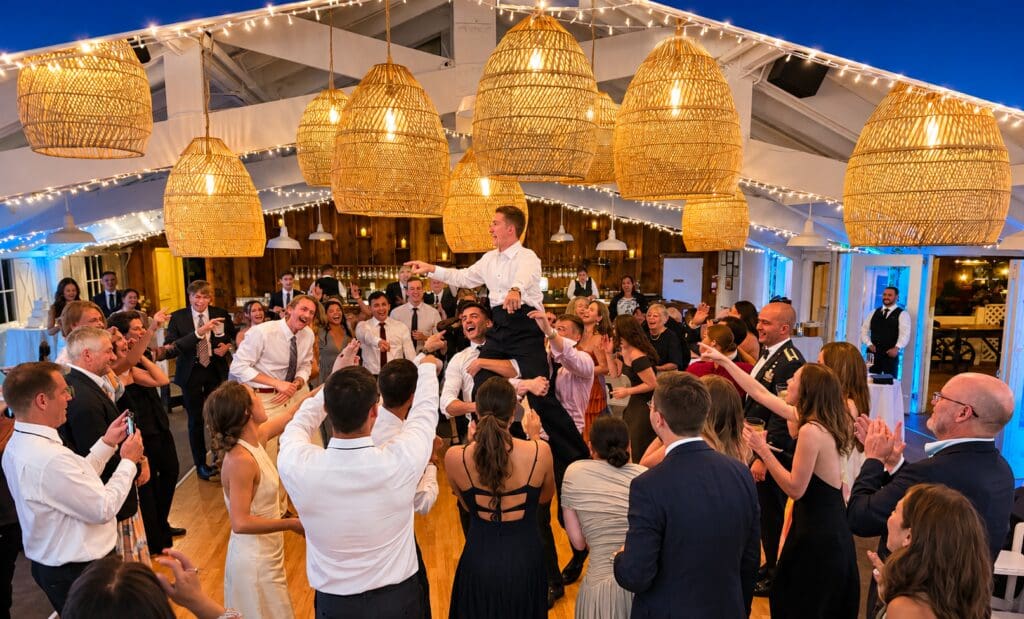
As you finalize your wedding plans, use the following questions to evaluate the celebration from your guests’ perspective.
Before the Wedding
- Have we provided enough advance notice for guests traveling from out of town?
- Have we recommended accommodations at different price points?
- Are hotel booking details, group codes, and reservation deadlines clearly communicated?
- Do guests understand the distance between their accommodations and the venue?
- Have we explained airport options and whether renting a vehicle is advisable?
- Are our RSVP instructions and deadlines easy to understand?
- Have we communicated our policies regarding children and additional guests?
Transportation and Arrival
- Does everyone have the correct venue address and entrance instructions?
- Are parking arrangements clearly explained?
- If we’re providing shuttle transportation, have guests received pickup and return schedules?
- Have we considered transportation for guests who may want to leave early?
- Have we accounted for traffic, mountain roads, and potential travel delays?
- Can guests access directions if cellular reception is limited?
Comfort and Accessibility
- Have we explained the expected weather and outdoor conditions?
- Will guests know whether they’ll be walking on grass, gravel, or uneven terrain?
- Is adequate seating available during the ceremony and cocktail hour?
- Are restrooms conveniently located and accessible?
- Have we considered the needs of elderly guests and people with mobility limitations?
- Are pathways and transportation areas safely illuminated after dark?
- Have we made appropriate arrangements for dietary restrictions and other communicated needs?
Ceremony and Reception
- Can guests comfortably hear the ceremony?
- Is there a smooth transition between the ceremony, cocktail hour, and reception?
- Are there refreshments and comfortable gathering spaces during cocktail hour?
- Does the timeline allow enough time for dinner, conversation, and dancing?
- Are important announcements clear and appropriately timed?
- Does the music reflect our personalities while welcoming guests of different ages and backgrounds?
- Have we accounted for the venue’s music restrictions and required ending time?
The Overall Destination Experience
- Have we recommended a manageable selection of local attractions and activities?
- Are optional gatherings clearly identified as optional?
- Have we avoided overscheduling the wedding weekend?
- Do guests know whom to contact if they have questions?
- Have we provided all important information in one easy-to-access location?
A thoughtful wedding doesn’t necessarily require saying yes to every item on this checklist.
It requires recognizing which details matter for your particular venue, guest list, and celebration.
17. The Secret to an Unforgettable Wedding Guest Experience
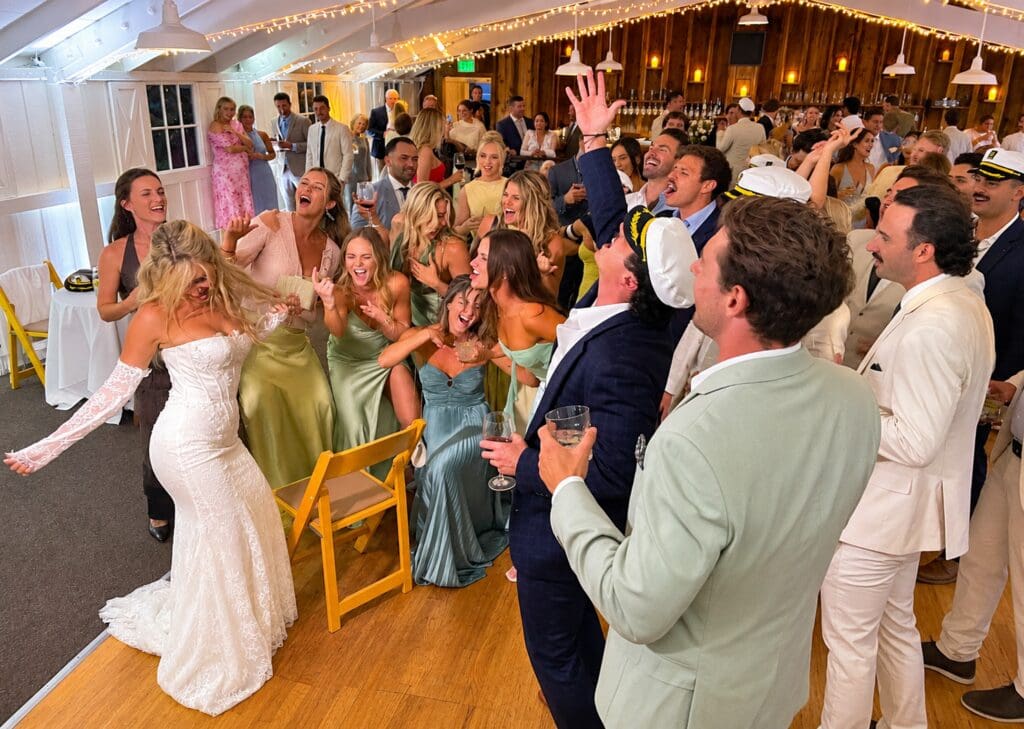
After more than 38 years in the wedding industry, I’ve come to believe that the most successful weddings share a quality that isn’t always obvious in photographs.
They feel natural.
Guests arrive knowing where they’re supposed to go.
The ceremony begins without unnecessary confusion.
Cocktail hour provides an opportunity to relax and reconnect.
Dinner unfolds comfortably, announcements are clear, and the evening progresses into a celebration that reflects the couple’s personalities.
Behind that seemingly effortless experience is usually a great deal of thoughtful planning.
Someone considered how guests would reach the venue.
Someone made sure elderly relatives could comfortably access the ceremony.
And someone coordinated the catering schedule, arranged transportation, and developed a reception timeline that allowed the evening to flow.
These details may not appear in the wedding album, but they contribute enormously to the memories guests take home.
The Atmosphere Matters More Than Perfection
Couples sometimes feel enormous pressure to create a flawless wedding.
Every detail must be coordinated, every decoration must look beautiful, and every activity must happen exactly as planned.
But after participating in nearly 3,000 weddings and special events, I can tell you that perfection isn’t what makes a wedding memorable.
Some of the most enjoyable celebrations I’ve experienced have included unexpected moments, spontaneous laughter, and changes to the original plan.
What matters is how comfortably the celebration accommodates those moments.
An experienced team of wedding professionals can adapt when circumstances change without allowing the adjustments to overwhelm the couple or their guests.
A well-organized wedding provides enough structure to keep everything moving while leaving room for the genuine emotions and spontaneous experiences that make the day special.
Your Guests Will Remember How They Felt
Years after your wedding, guests may not remember the exact menu or the flowers on their dinner table.
They may, however, remember the warmth of the ceremony, the conversations they shared with old friends, the beauty of the setting, and the excitement of celebrating together.
They’ll remember the songs that brought everyone onto the dance floor, the laughter during the toasts, and the moments when multiple generations came together.
These experiences don’t happen because every detail was expensive or elaborate.
They happen because the couple created an environment where people felt welcome, comfortable, and connected.
That’s the true value of thoughtful guest experience planning.
The Wedding Should Still Be Yours
There’s one final distinction I believe every couple should understand.
Considering your guests doesn’t mean sacrificing the wedding you want.
Your wedding should reflect your relationship, your personalities, your traditions, and your priorities.
If you dream of a romantic ceremony in Big Sur, don’t automatically abandon that vision because some guests will need additional travel arrangements.
If you love the redwoods of Ben Lomond, don’t feel obligated to choose a conventional ballroom simply because it might be more convenient.
Instead, recognize the practical considerations associated with your preferred location and determine how to address them.
Thoughtful guest planning should support your vision, not replace it.
The goal is to find a balance between creating the celebration you’ve imagined and making the experience enjoyable for the people who matter most.
18. Your Wedding, Your Way — With an Experience Your Guests Will Never Forget

California’s Central Coast offers an extraordinary setting for destination weddings.
From the romantic streets of Carmel-by-the-Sea and the historic waterfront of Monterey to the vineyards of Carmel Valley, the dramatic coastline of Big Sur, and the towering redwoods surrounding Santa Cruz and Ben Lomond, the region provides countless opportunities to create a celebration unlike any other.
But the location is only part of the experience.
The way guests travel to your wedding, the accommodations they choose, the information they receive, and the atmosphere they encounter throughout the celebration all contribute to how they remember the occasion.
Thoughtful planning doesn’t have to be complicated or expensive.
Sometimes it means providing clear driving directions, recommending several hotels, arranging reliable transportation, or reminding guests to bring a jacket for a cool coastal evening.
Other times, it means creating a reception timeline that allows people to relax, enjoy a wonderful meal, reconnect with family and friends, and spend plenty of time celebrating together.
As a professional wedding DJ and Master of Ceremonies, I’ve always believed that my responsibilities extend beyond simply playing music.
Understanding the couple’s vision, coordinating with other wedding professionals, maintaining a smooth reception timeline, communicating clearly with guests, and knowing how to read a room are all essential parts of creating a successful celebration.
The best weddings aren’t necessarily the most expensive, elaborate, or traditional.
They’re the ones where the couple feels genuinely happy, the guests feel welcome, and everyone has the opportunity to enjoy something meaningful together.
So as you plan your destination wedding in Carmel, Monterey, Big Sur, Santa Cruz, or the surrounding Central Coast communities, take the time to imagine the celebration through your guests’ eyes.
Consider their journey, their comfort, and the memories they’ll take home.
Then create a wedding that reflects who you are while welcoming the people you’ve chosen to share it with.
Because long after the last song has played and the final guests have returned home, the memories of a wonderful celebration are what remain.
And those memories are what make a wedding truly unforgettable.
By DJ Justin Warwick of DJ Enterprises Mobile Disc Jockey, aka DJ Warwick

Justin Warwick. The dynamic force behind DJ Enterprises Mobile Disc Jockey, has been a trailblazer in professional wedding DJ entertainment since 1989. Serving the Central Coast Monterey Bay area and beyond. Justin specializes in creating unforgettable experiences for weddings, corporate events, New Years, anniversaries, birthdays, and a variety of social events. Known for his ability to bring joy, fun, excitement, and energy to every event. Justin’s expertise ensures a memorable experience for you and your guests. One of Justin’s standout contributions to the wedding world is the “Table Dash game,” also known as the “Photo Dash game”, a high–energy reception activity he created in the early–2000s.
With thousands of successful events under his belt, Justin Warwick is renowned for his exceptional DJ and MC skills. He has a unique ability to read the crowd and tailor the music to fit the atmosphere perfectly. Whether it’s an intimate gathering or a grand celebration. Justin’s extensive music knowledge and state-of-the-art equipment guarantee a seamless and enjoyable event.
For those planning an event in the Carmel, Pebble Beach, Santa Cruz and Monterey Bay area. The Monterey Wedding DJ Blog offers a wealth of tips and ideas. It’s the most-read wedding DJ blog in California. Providing insights into crafting the perfect playlist, reading about local venues, and staying updated on the latest trends in wedding and event planning.
“I’d love the opportunity to be your wedding or companies Holiday Office Party DJ and provide Photo Booth services.” Reach out to me at dj.justinwarwick@gmail.com or visit (https://djwarwick.com) for more information. I look forward to hearing from you!
Explore the website for more details on services, pricing, and client testimonials to see why DJ Justin Warwick is the best choice for your next event. https://djwarwick.com